EPOC
An AI system that manages IoT devices and data inputs to deliver real-time, actionable knowledge
Source: squarespace-export/images/epoc/001.JPG–034.png (34 slides). Credits on original: Noel Gonzalez | Rithesh Rama
Suggested title & subtitle
Title: EPOC Subtitle A (from slide 030's own tagline): "Epoc AI manages all data inputs so the user won't have to — giving the user close to real-time actionable knowledge." Subtitle B (shorter): An AI system that manages IoT devices and data inputs to deliver real-time, actionable knowledge.
Section 0 — Overview / Executive Summary (slides 001–004)
Four-slide front-loaded summary (concept → problem → approach → outcome), each tagged bottom-left: "Topic of Interest," [Problem], "Approach," "Expected outcome."
Topic of Interest — E Consciousness
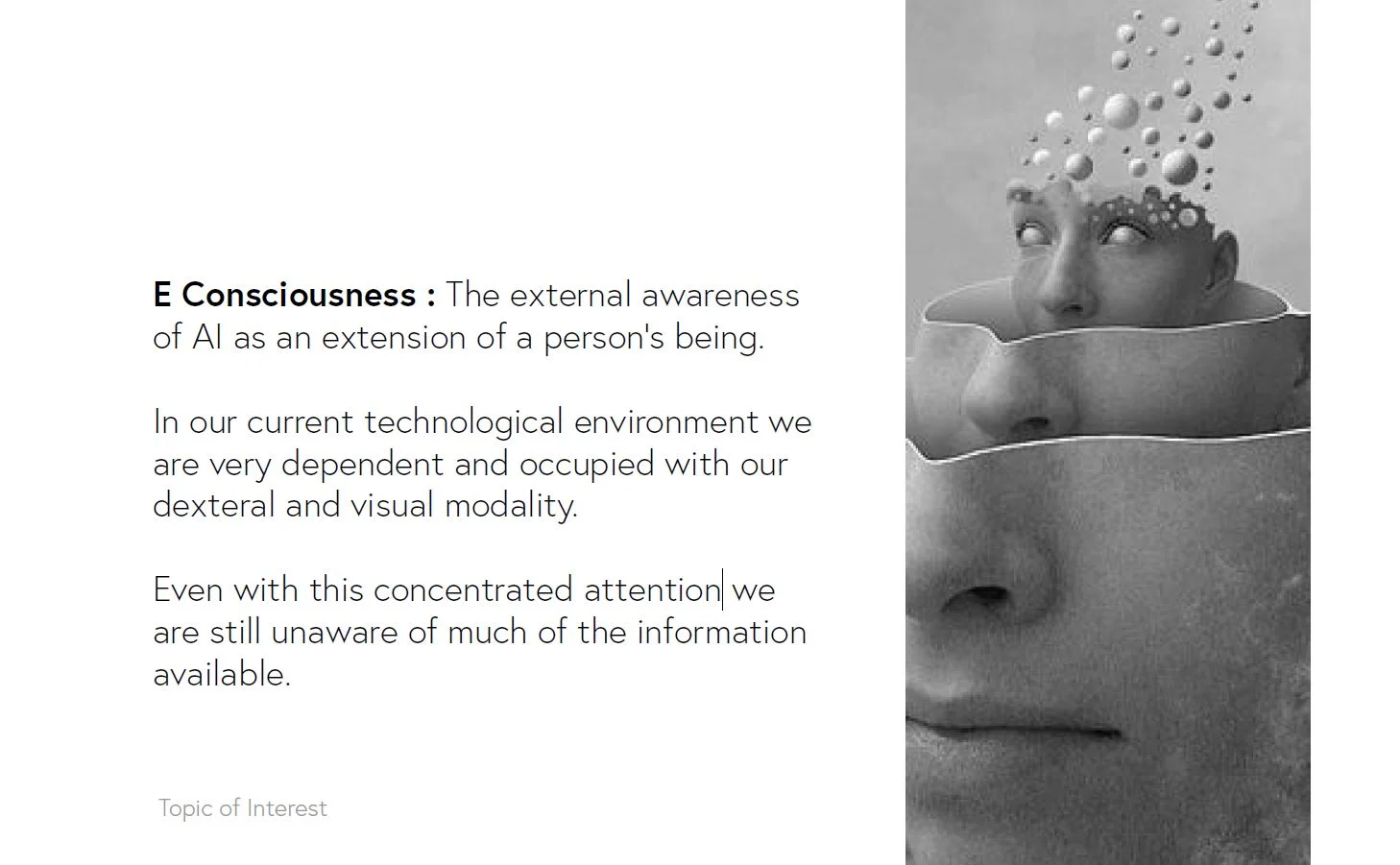
E Consciousness: The external awareness of AI as an extension of a person's being.
In our current technological environment we are very dependent and occupied with our dexteral and visual modality.
Even with this concentrated attention we are still unaware of much of the information available.
Visual (001): Grayscale illustration of a person's head "opened" like a lid, spheres/bubbles rising out — external AI awareness extending consciousness.
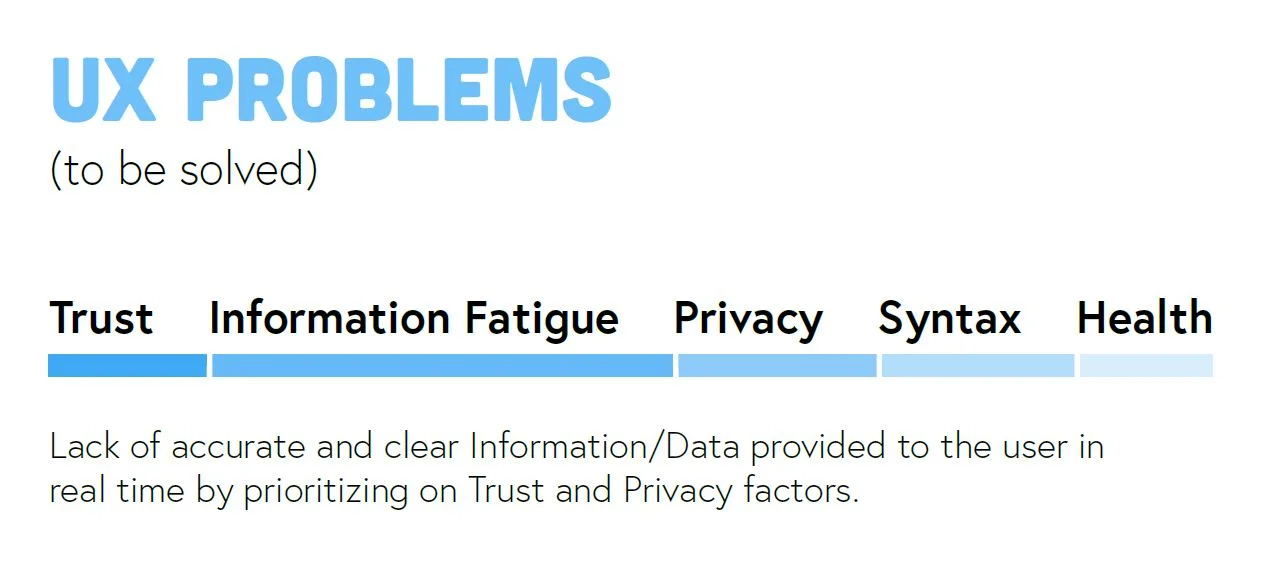
UX Problems (to be solved)
Lack of accurate and clear Information/Data provided to the user in real time by prioritizing on Trust and Privacy factors.
Visual (002): Horizontal priority ranking: Trust, Information Fatigue, Privacy, Syntax, Health.
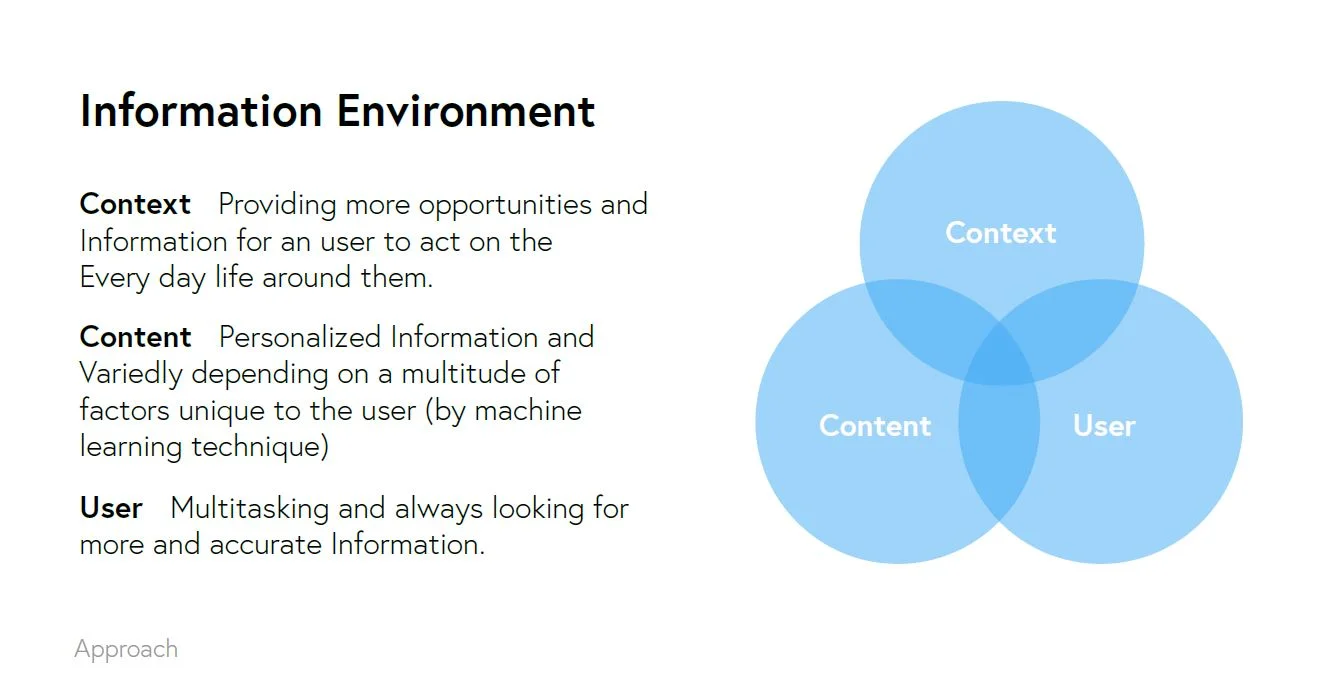
Approach — Information Environment
Context Providing more opportunities and Information for an user to act on the Every day life around them.
Content Personalized Information and Variedly depending on a multitude of factors unique to the user (by machine learning technique)
User Multitasking and always looking for more and accurate Information.
Visual (003): Three-circle Venn diagram — Context / Content / User.
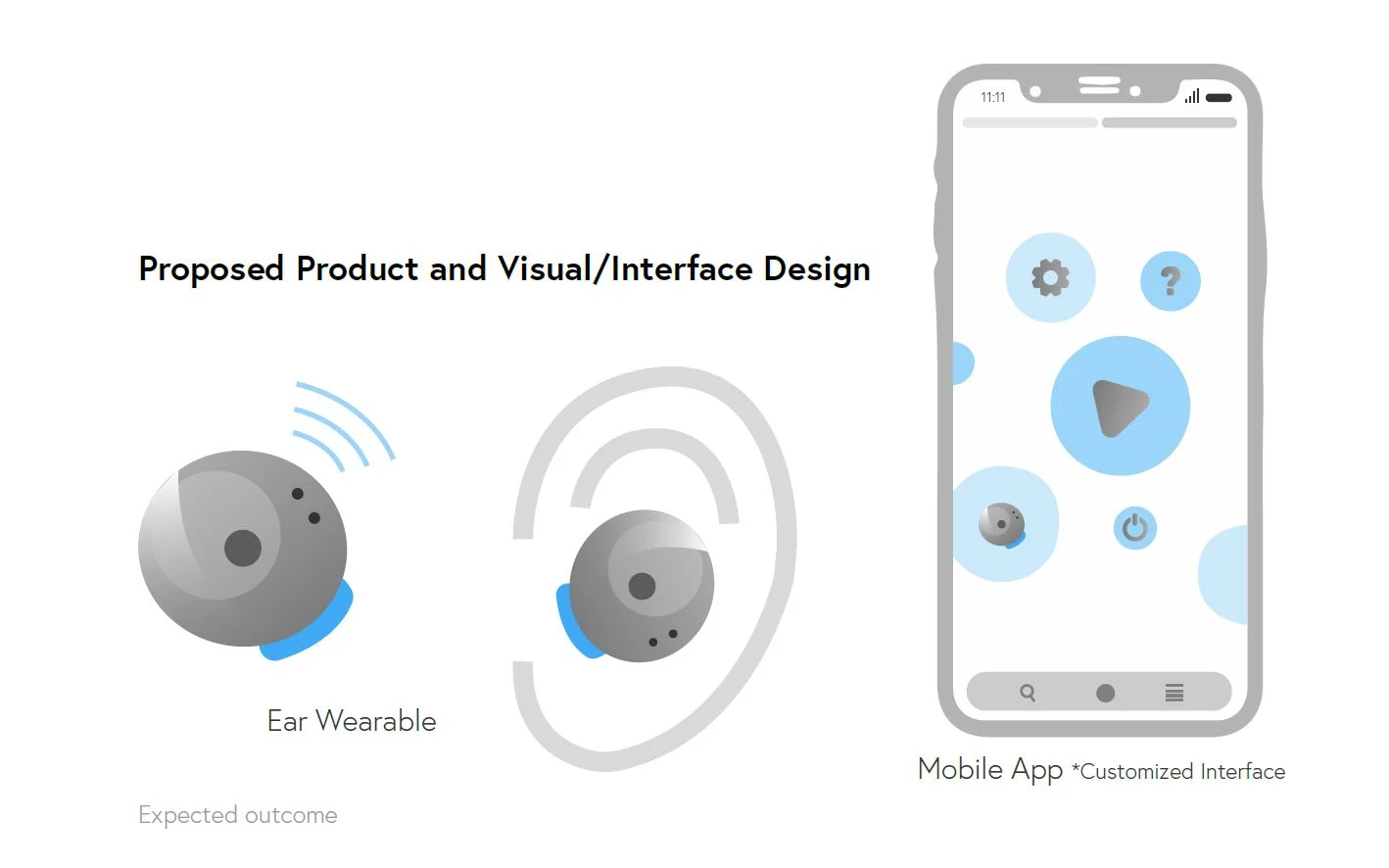
Proposed Product and Visual/Interface Design (Expected Outcome)
No body paragraph. Visual (004): Early concept art — round gray "Ear Wearable" device with blue accent band (standalone + fitted on an illustrated ear), plus a "Mobile App" phone mockup (pulsing-icon home screen: settings gear, help "?", center play button, device icon, power icon). Labeled "*Customized Interface."
Section 1 — Research (slides 005–008)
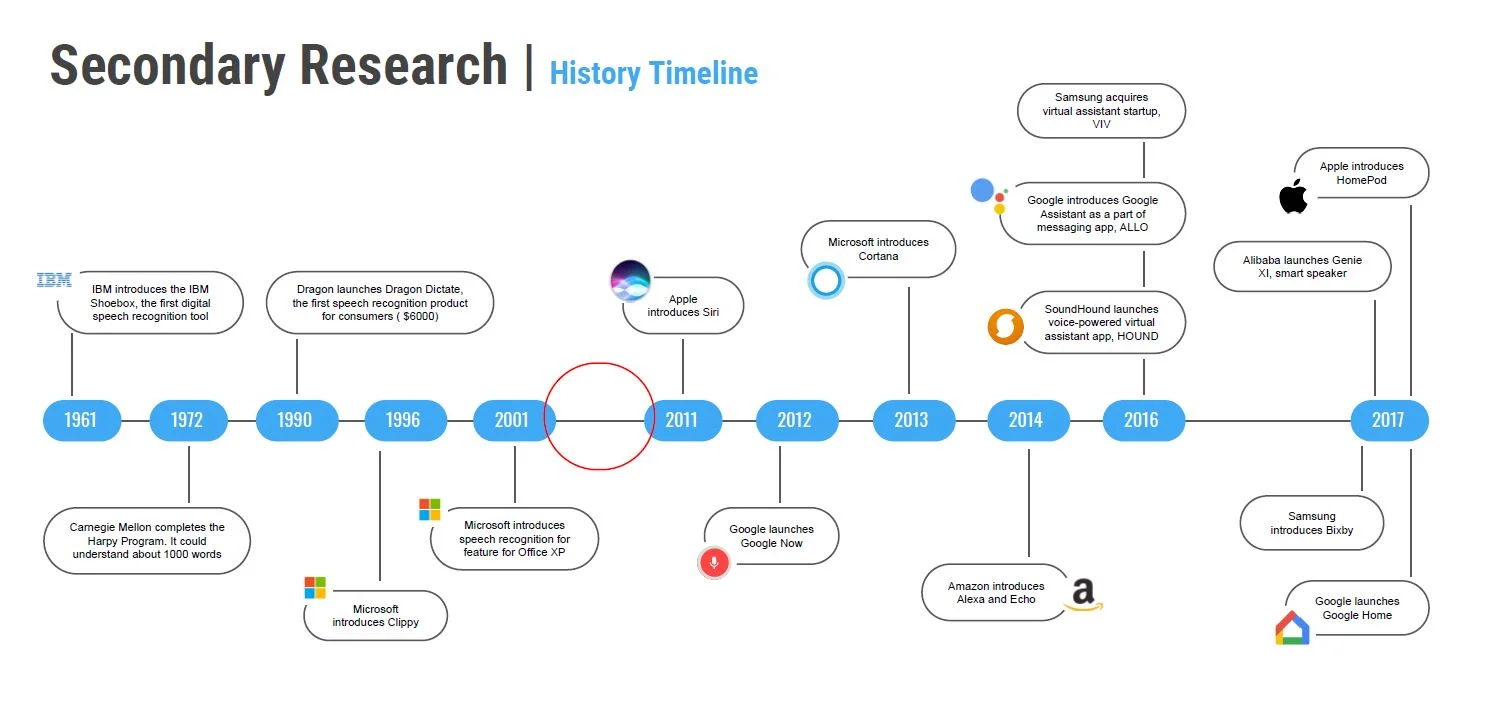
Secondary Research — History Timeline
No paragraph copy — pure timeline (005), voice-assistant/speech-recognition history 1961–2017:
- 1961 – IBM Shoebox, first digital speech recognition tool
- 1972 – Carnegie Mellon's Harpy Program (~1000 words)
- 1990 – Dragon Dictate, first consumer speech recognition product ($6000)
- 1996 – Microsoft Clippy; speech recognition for Office XP
- 2001 – (marked, unlabeled)
- 2011 – Apple Siri
- 2012 – Google Now
- 2013 – Microsoft Cortana
- 2014 – Amazon Alexa/Echo; Samsung acquires VIV; Google Assistant in ALLO; SoundHound HOUND
- 2016 – Alibaba Genie X1; Apple HomePod
- 2017 – Samsung Bixby; Google Home
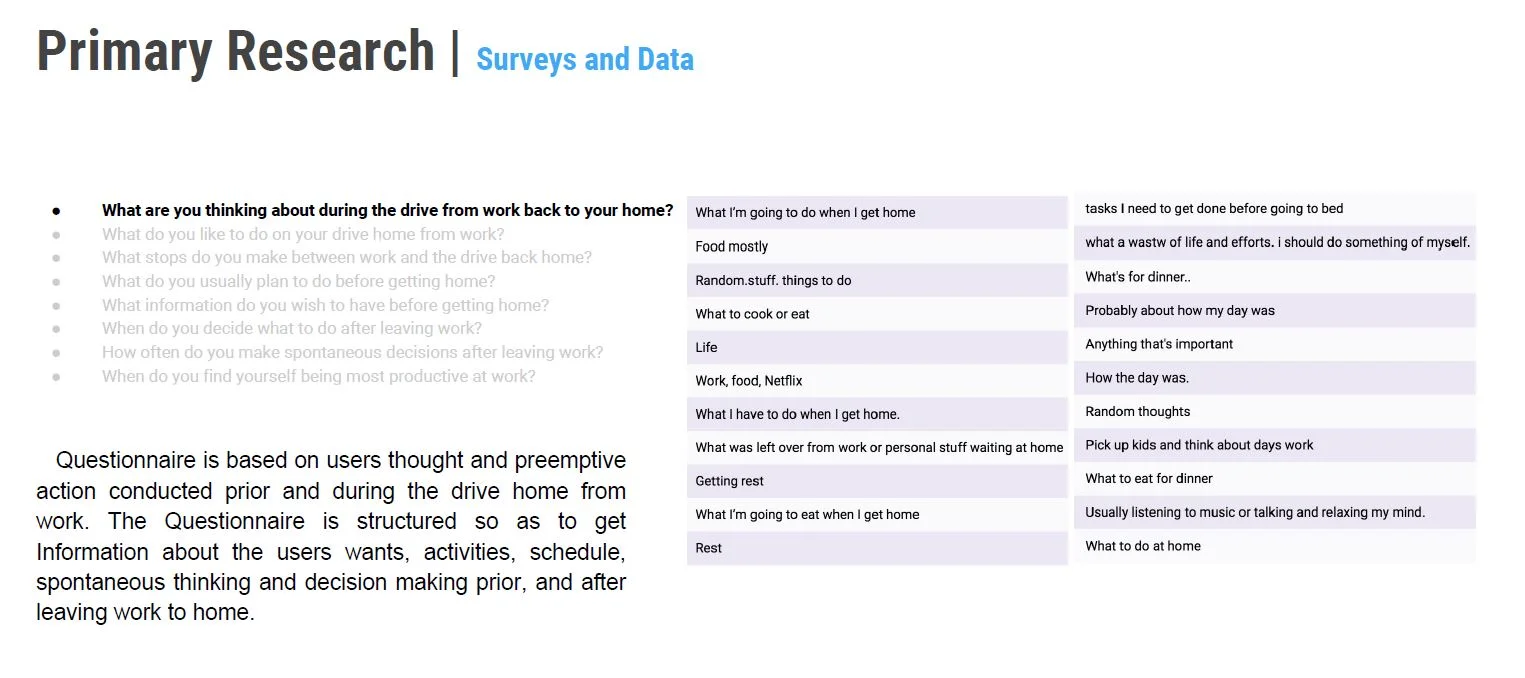
Primary Research — Surveys and Data
Questionnaire is based on users thought and preemptive action conducted prior and during the drive home from work. The Questionnaire is structured so as to get Information about the users wants, activities, schedule, spontaneous thinking and decision making prior, and after leaving work to home.
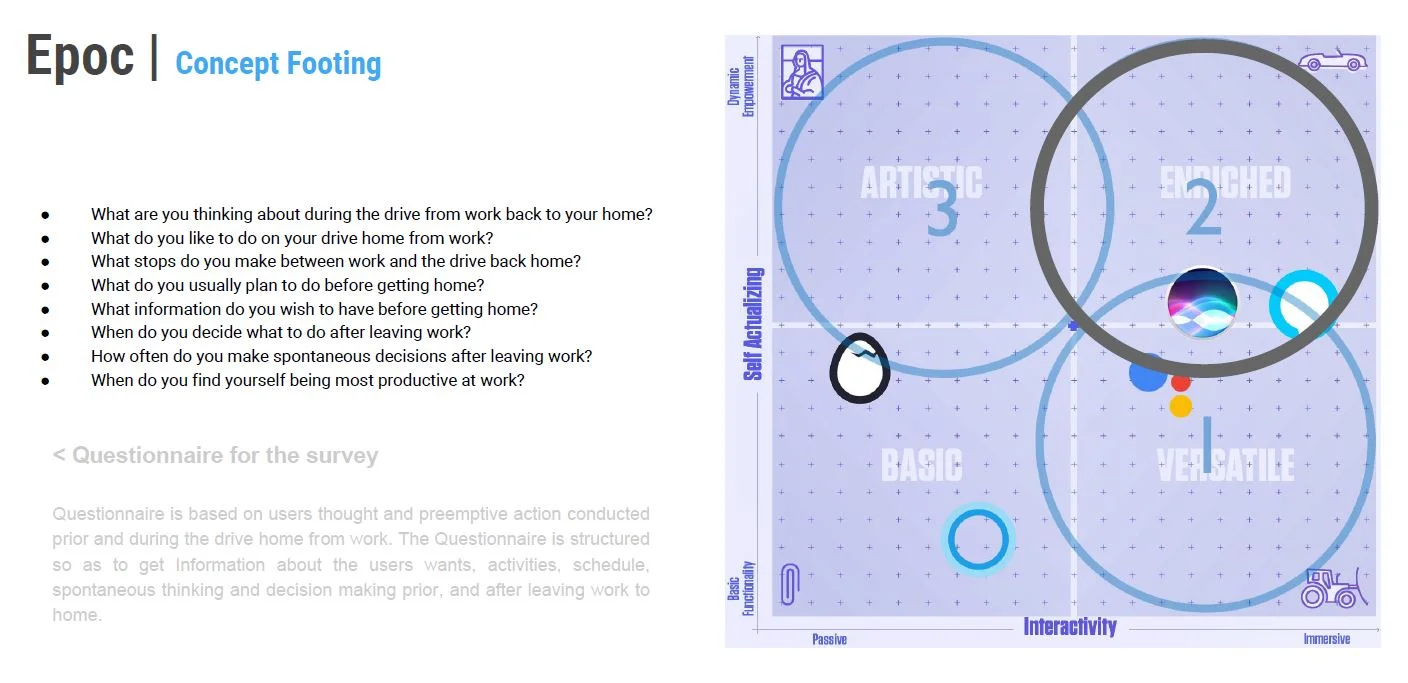
Focal survey question: "What are you thinking about during the drive from work back to your home?" Other questions: What do you like to do on your drive home from work? / What stops do you make between work and the drive back home? / What do you usually plan to do before getting home? / What information do you wish to have before getting home? / When do you decide what to do after leaving work? / How often do you make spontaneous decisions after leaving work? / When do you find yourself being most productive at work?
Visual (006): raw verbatim survey responses table — "What I'm going to do when I get home" / "Food mostly" / "Random.stuff. things to do" / "What to cook or eat" / "Life" / "Work, food, Netflix" / "What I have to do when I get home." / "What was left over from work or personal stuff waiting at home" / "Getting rest" / "What I'm going to eat when I get home" / "Rest" / "tasks I need to get done before going to bed" / "what a wastw of life and efforts. i should do something of myself." / "What's for dinner.." / "Probably about how my day was" / "Anything that's important" / "How the day was." / "Random thoughts" / "Pick up kids and think about days work" / "What to eat for dinner" / "Usually listening to music or talking and relaxing my mind." / "What to do at home"
Primary Research — Personas (slide 007)
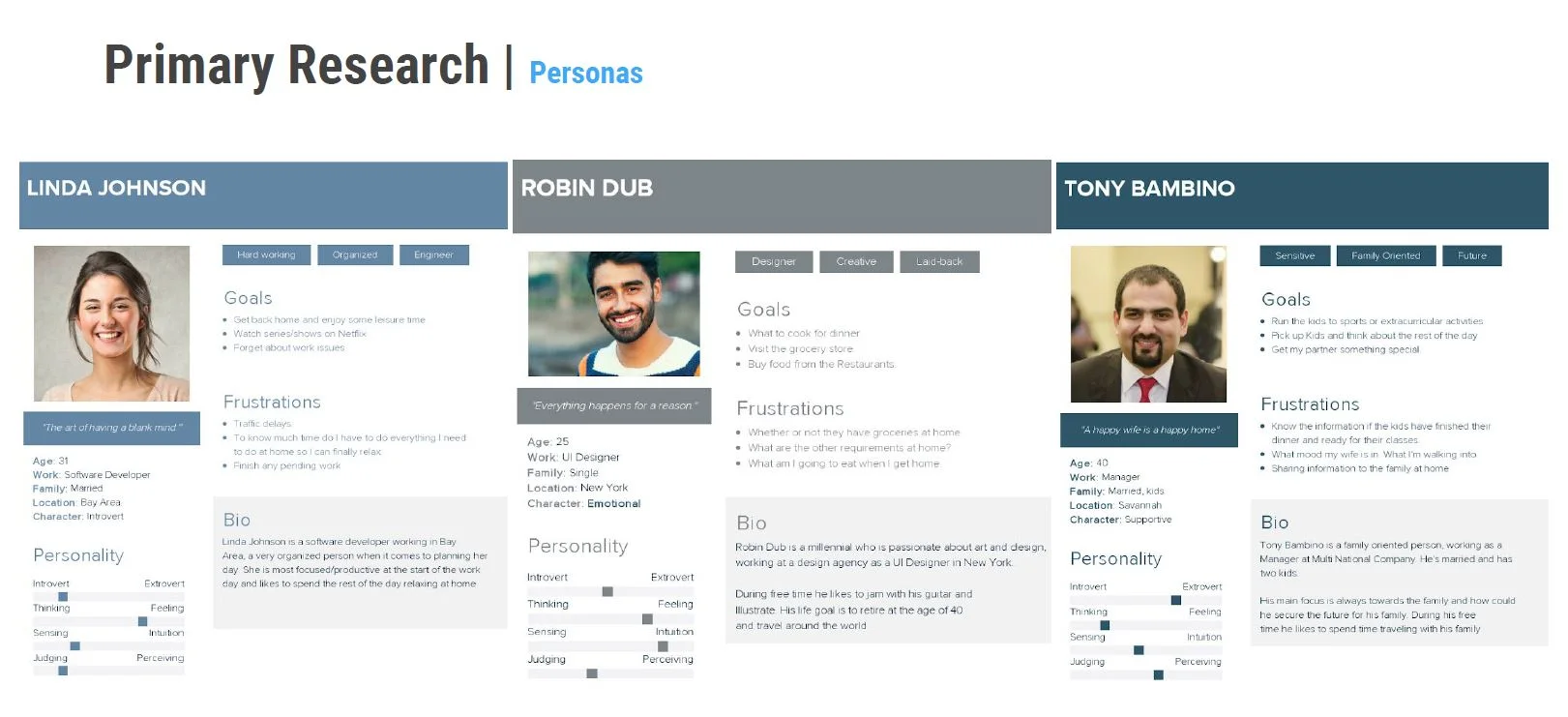
Linda Johnson — Hard working, Organized, Engineer. "The art of having a blank mind." Age 31, Software Developer, Married, Bay Area, Introvert. Goals: Get back home and enjoy some leisure time; Watch series/shows on Netflix; Forget about work issues. Frustrations: Traffic delays; knowing how much time to do everything at home so I can finally relax; Finish any pending work. Bio: "Linda Johnson is a software developer working in Bay Area, a very organized person when it comes to planning her day. She is most focused/productive at the start of the work day and likes to spend the rest of the day relaxing at home."
Robin Dub — Designer, Creative, Laid-back. "Everything happens for a reason." Age 25, UI Designer, Single, New York, Emotional. Goals: What to cook for dinner; Visit the grocery store; Buy food from the Restaurants. Frustrations: Whether or not they have groceries at home; other requirements at home; what to eat when getting home. Bio: "Robin Dub is a millennial who is passionate about art and design, working at a design agency as a UI Designer in New York. During free time he likes to jam with his guitar and Illustrate. His life goal is to retire at the age of 40 and travel around the world."
Tony Bambino — Sensitive, Family Oriented, Future. "A happy wife is a happy home." Age 40, Manager, Married w/ kids, Savannah, Supportive. Goals: Run the kids to sports/extracurriculars; Pick up Kids and think about the rest of the day; Get my partner something special. Frustrations: Knowing if the kids finished dinner and are ready for classes; what mood my wife is in; sharing information with family at home. Bio: "Tony Bambino is a family oriented person, working as a Manager at Multi National Company. He's married and has two kids. His main focus is always towards the family and how could he secure the future for his family. During his free time he likes to spend time traveling with his family."
(Note: "Bambino" is reused as the protagonist's name in the later storyboards.)
User Journey Map (slide 008)
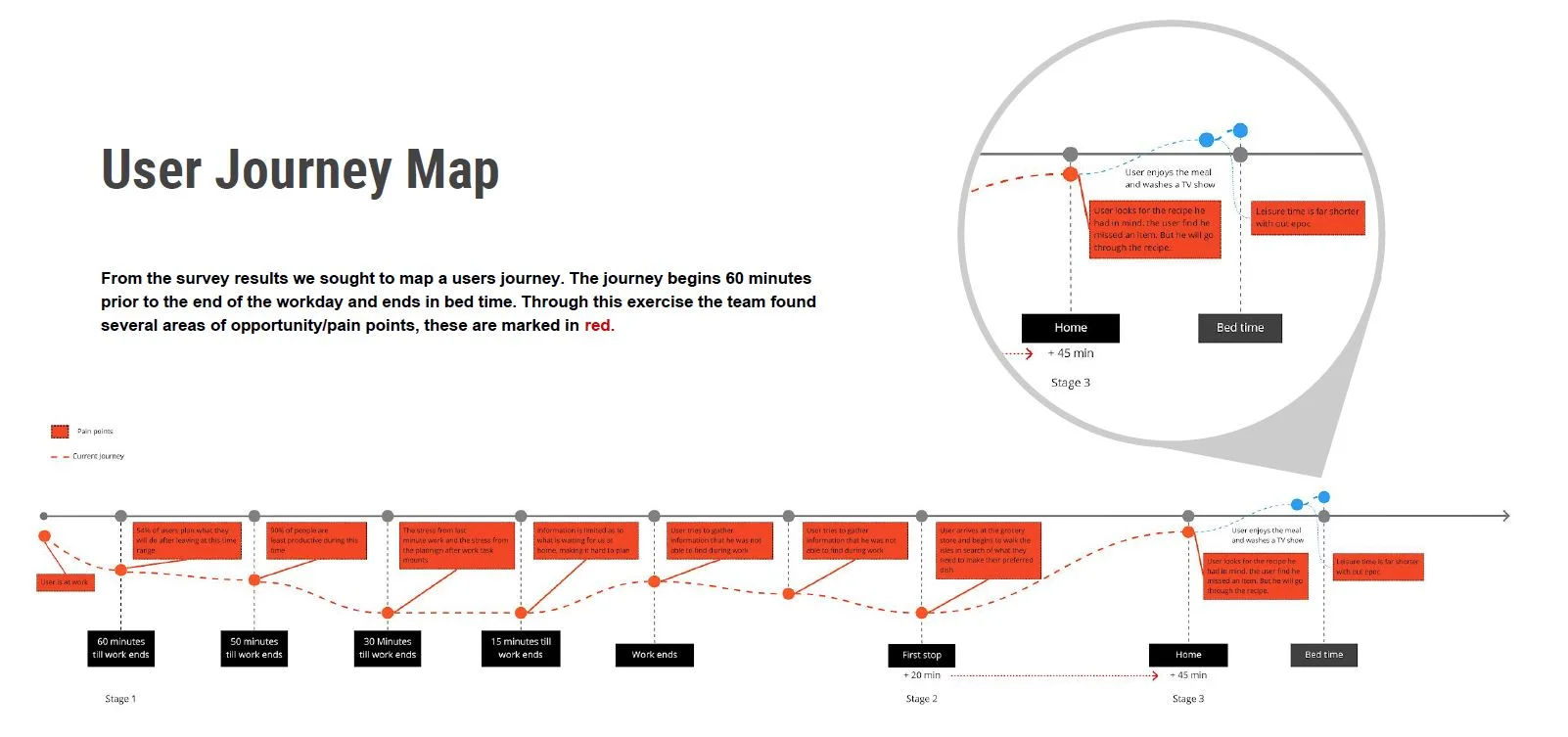
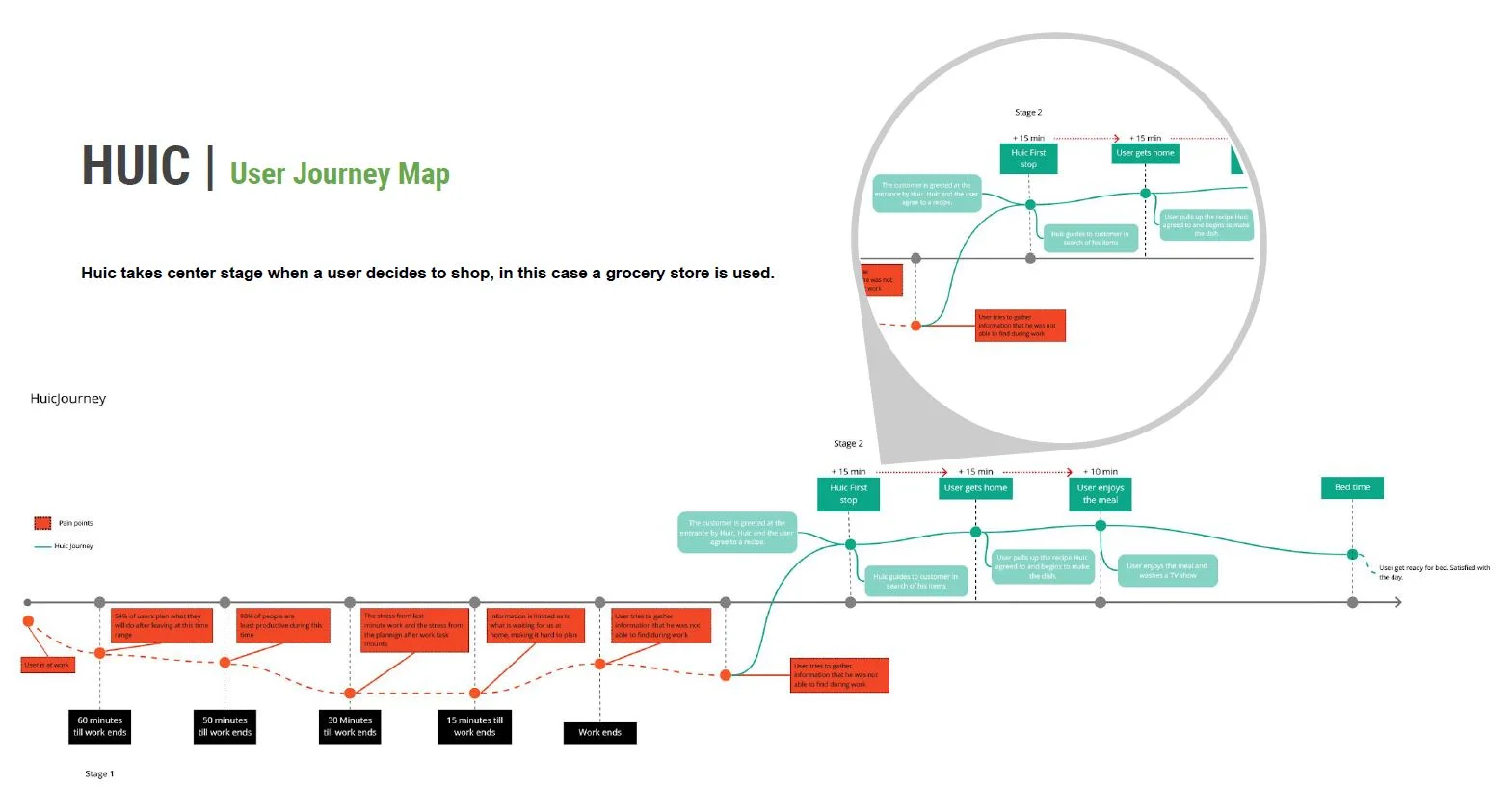
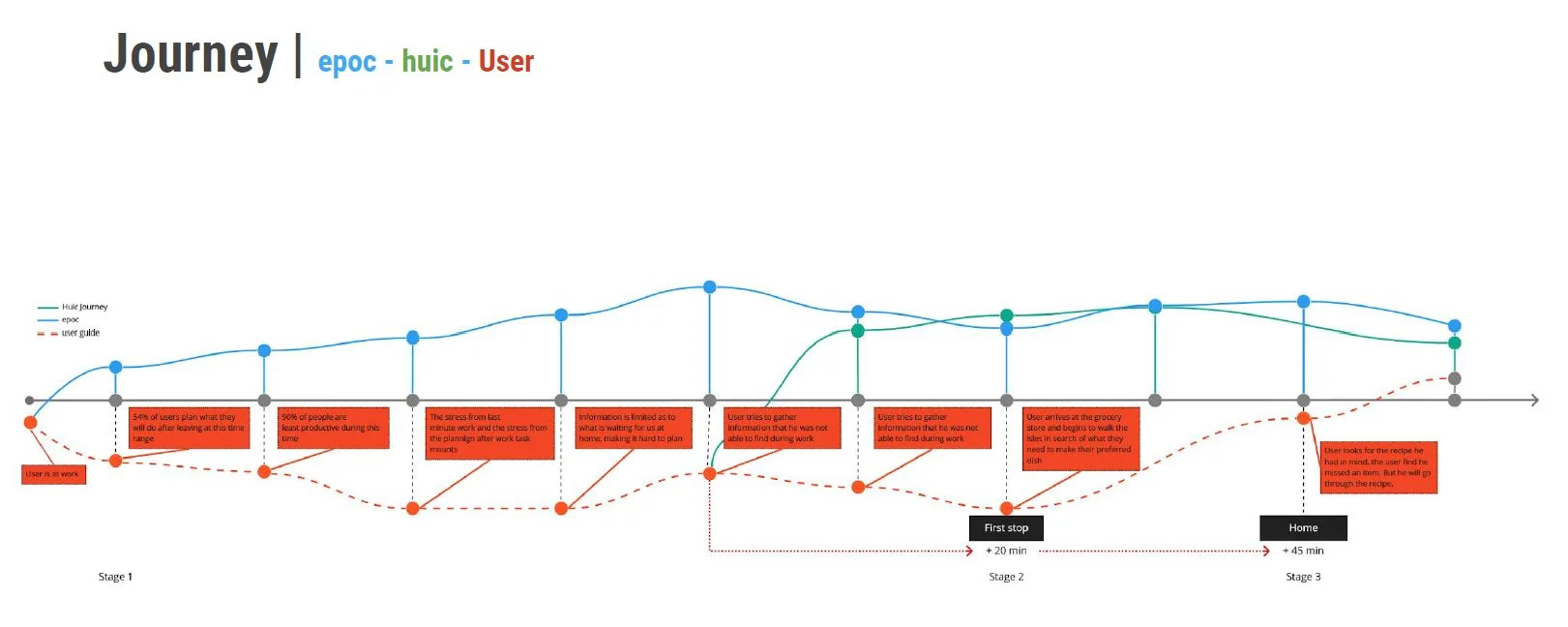
From the survey results we sought to map a users journey. The journey begins 60 minutes prior to the end of the workday and ends in bed time. Through this exercise the team found several areas of opportunity/pain points, these are marked in red.
Timeline: red dashed = "Current Journey," red boxes = pain points. Stage 1 (60/50/30/15 min till work ends) → Stage 2 (work ends → first stop, +20 min) → Stage 3 (home +45 min → bed time). Pain points:
- "54% of users plan what they will do after leaving at this time range" (60 min)
- "90% of people are least productive during this time" (50 min)
- "The stress from last minute work and the stress from the plannign after work task mounts" (30 min)
- "Information is limited as to what is waiting for us at home, making it hard to plan" (15 min)
- "User tries to gather information that he was not able to find during work" (work ends, and again at first stop)
- "User arrives at the grocery store and begins to walk the isles in search of what they need to make their preferred dish"
- "User looks for the recipe he had in mind, the user find he missed an item. But he will go through the recipe." (Home)
- "Leisure time is far shorter with out epoc" (Bed time)
- "User enjoys the meal and washes [watches] a TV show"
Section 2 — Concept Positioning (slides 009–010)
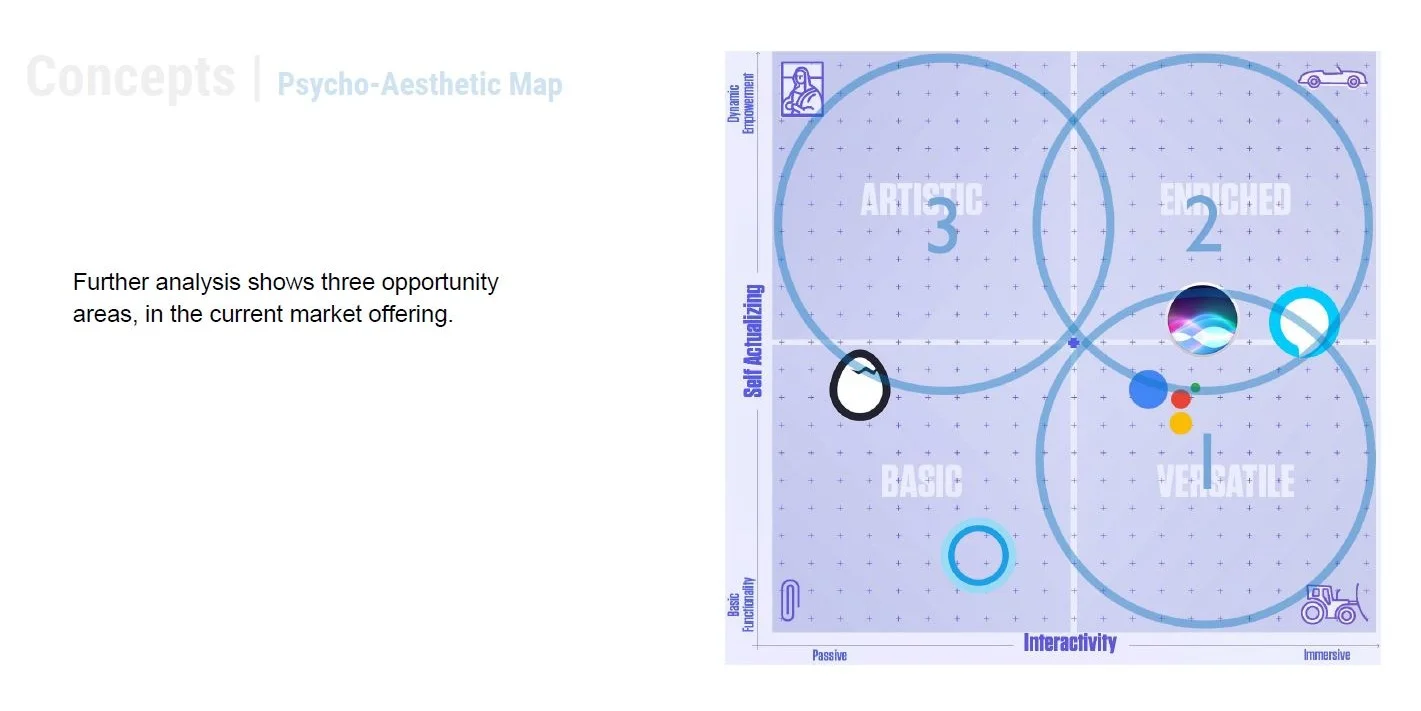
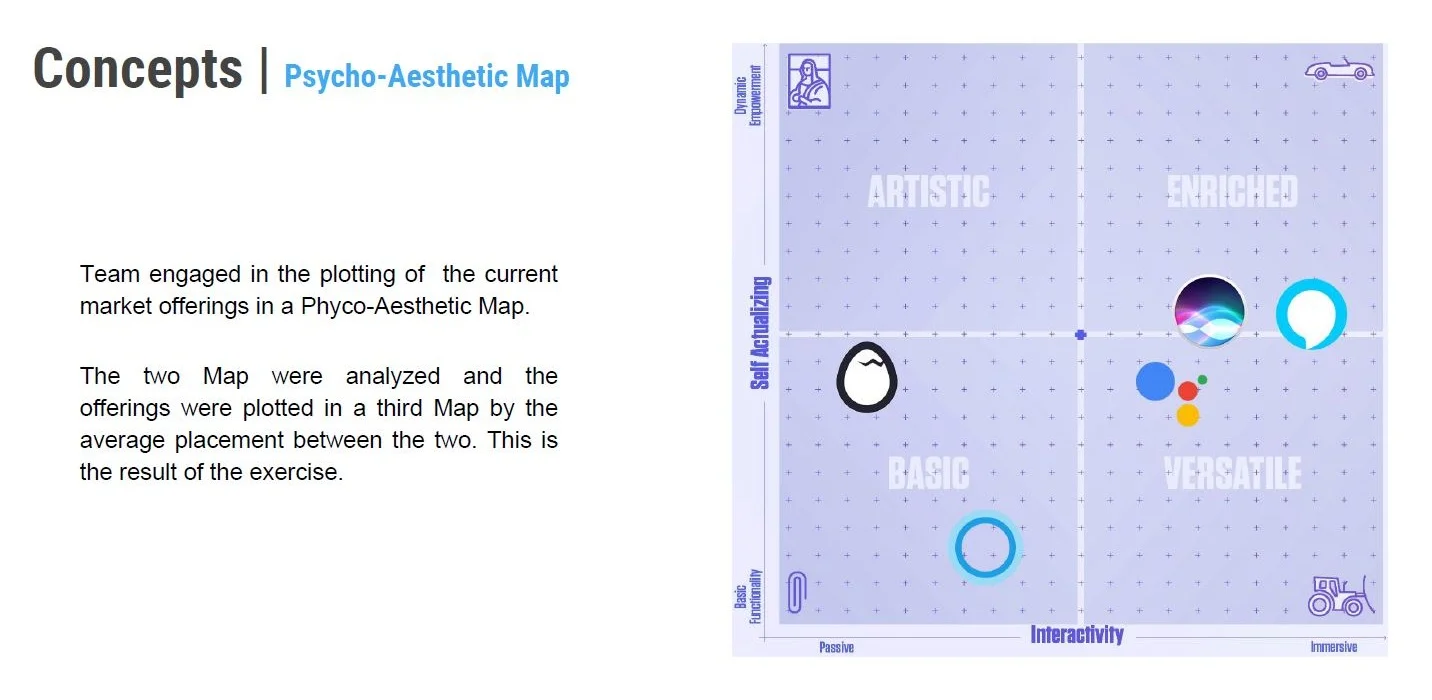 "Further analysis shows three opportunity areas, in the current market offering." / "Team engaged in the plotting of the current market offerings in a Phyco-Aesthetic [Psycho-Aesthetic] Map. The two Map were analyzed and the offerings were plotted in a third Map by the average placement between the two. This is the result of the exercise."
Visual: 2x2 quadrant map, axes "Self Actualizing" (Dynamic Empowerment ↔ Basic Functionality) and "Interactivity" (Passive ↔ Immersive). Zones: Artistic, Enriched, Versatile, Basic. Competitors plotted: Siri, Google Assistant, Alexa — clustering in Enriched/Versatile overlap, the identified opportunity zone.
Section 3 — Naming: "Huic" → "Epoc" (slides 011–019)
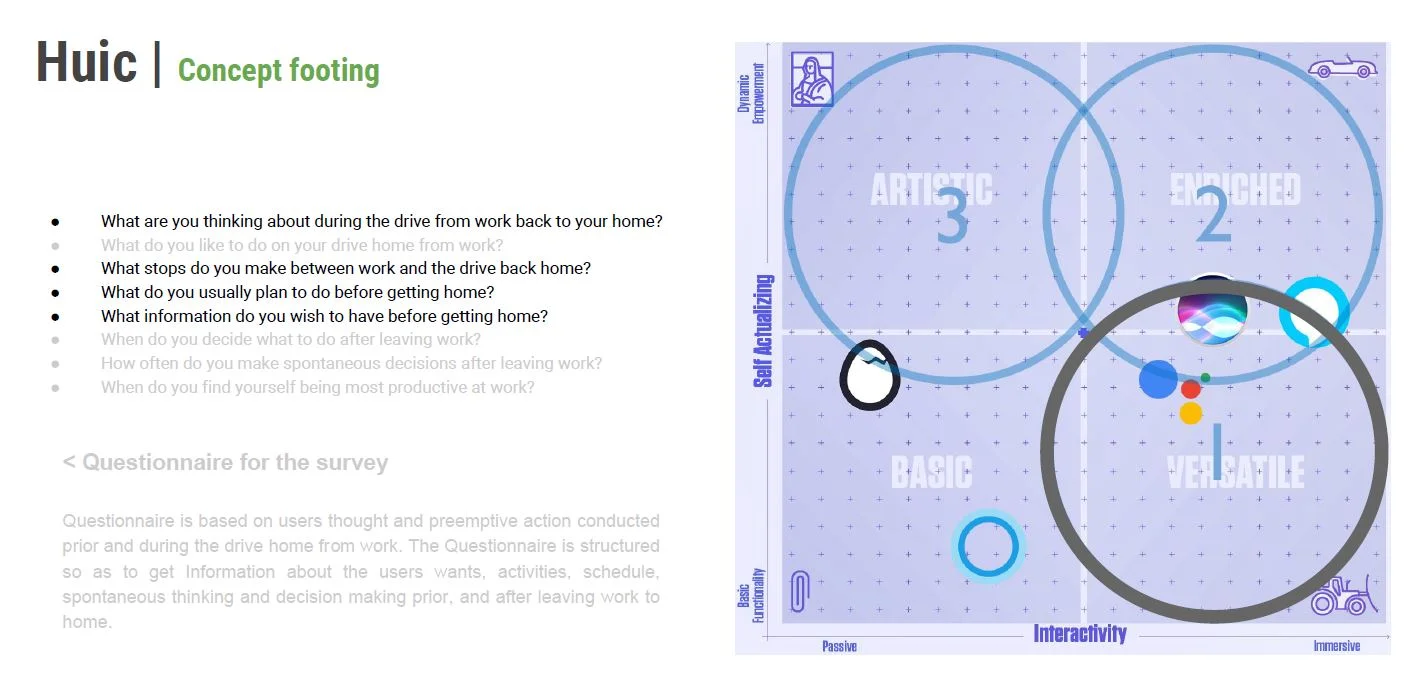

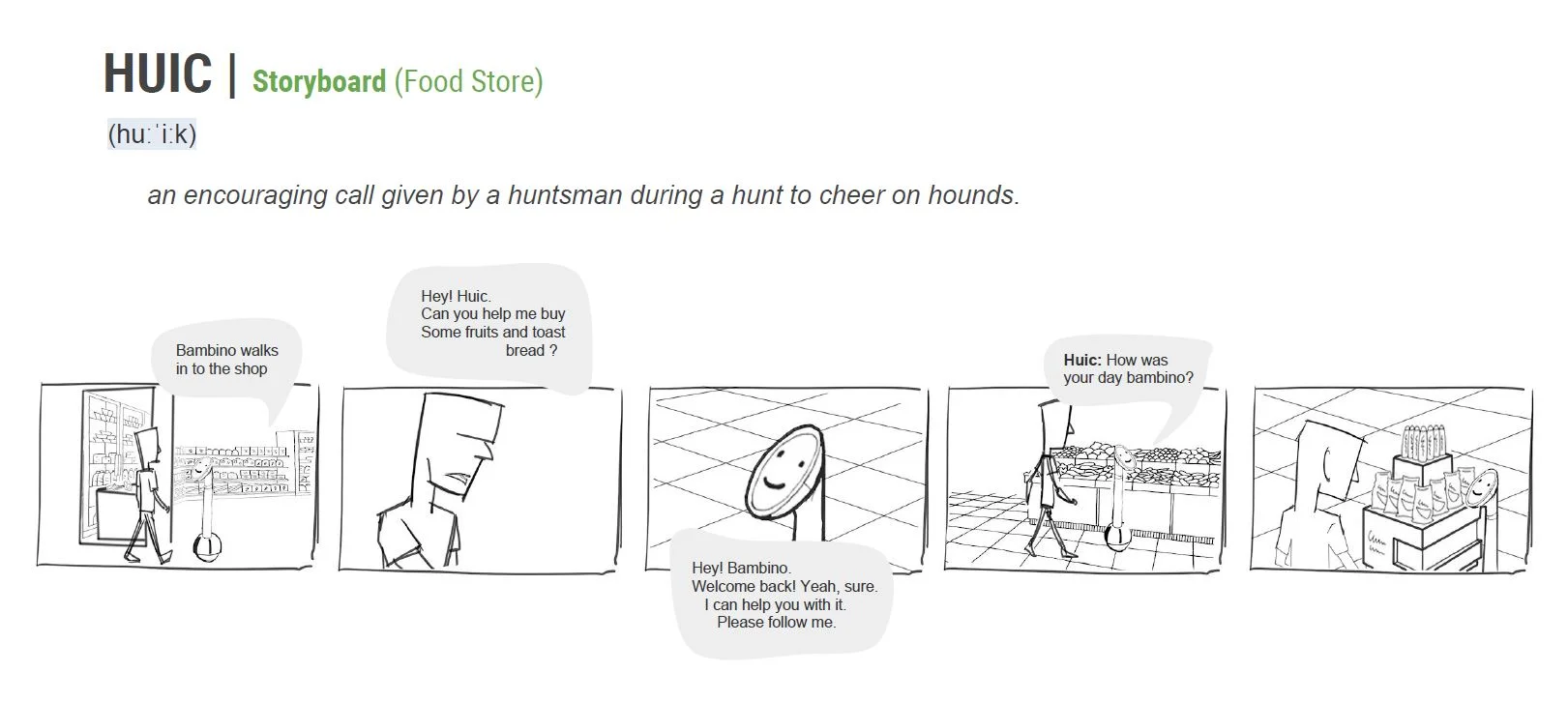
 Same concept developed/tested under working name Huic before renaming to Epoc. Research questions, market map, and journey map reused nearly identically under both names.
HUIC (hu:'i:k) — "an encouraging call given by a huntsman during a hunt to cheer on hounds."
Storyboard (013, grocery store): Bambino: "Hey! Huic. Can you help me buy Some fruits and toast bread?" Huic: "Hey! Bambino. Welcome back! Yeah, sure. I can help you with it. Please follow me." / "How was your day bambino?"
Huic journey map (014): same pain-point timeline, relabeled "HuicJourney." Zoom detail: "The customer is greeted at the entrance by Huic. Huic and the user agree to a recipe." → "Huic guides the customer in search of his items" → "User pulls up the recipe Huic agreed to and begins to make the dish."
Rebrand to Epoc (blue), same concept-footing content.
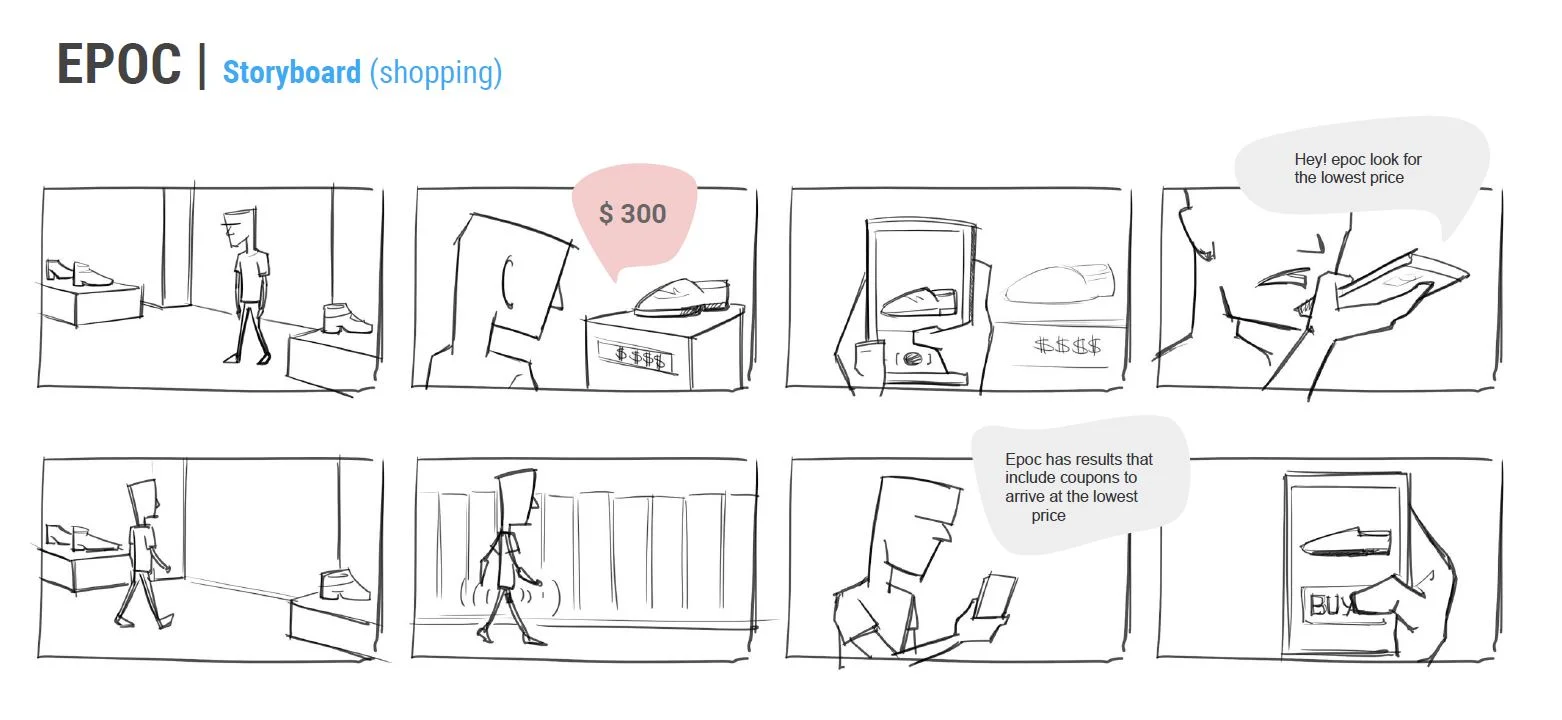
Storyboard (016, shopping): man sees shoe priced "$300," scans at register ("$$$$"): "Hey! epoc look for the lowest price" → "Epoc has results that include coupons to arrive at the lowest price" → phone screen with BUY button.
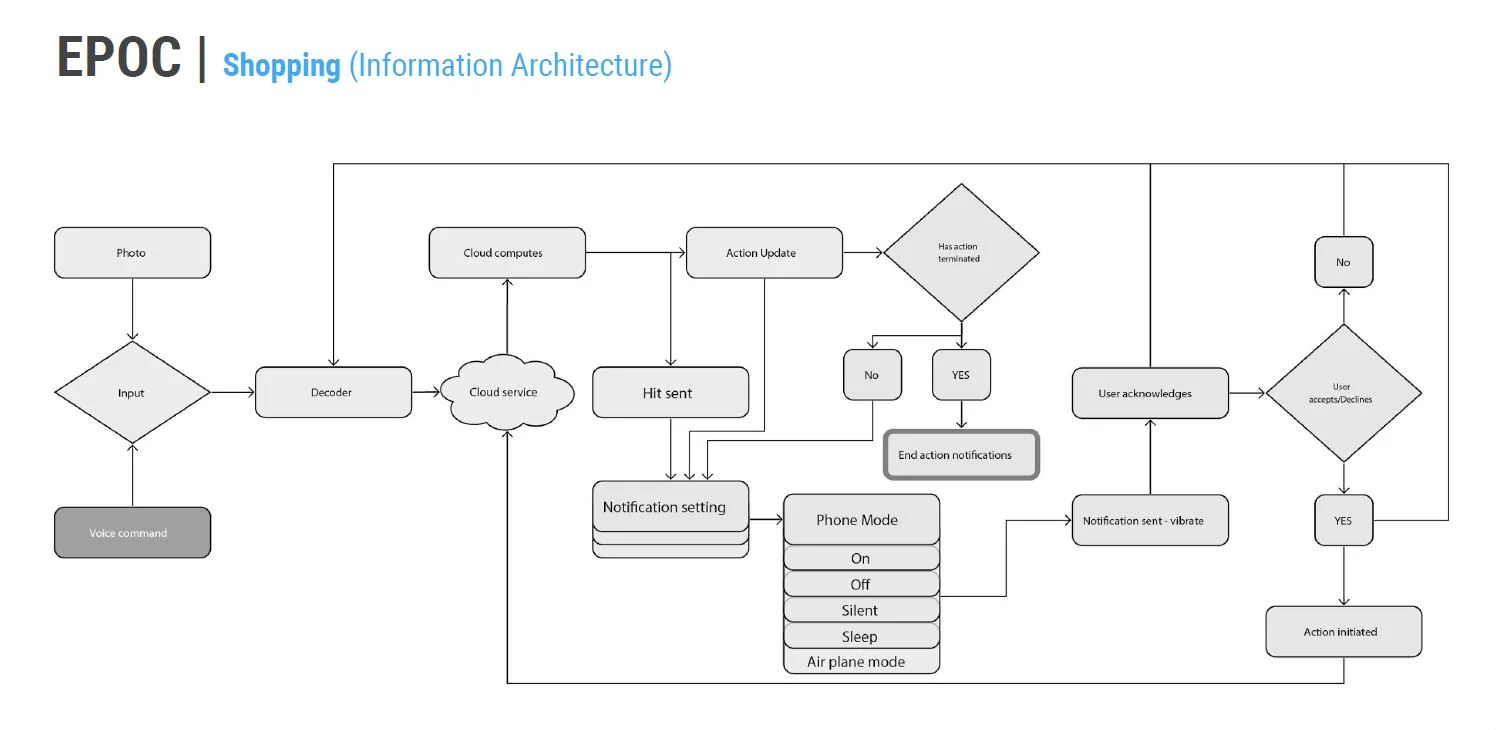
Shopping IA flowchart (017): Voice command / Photo inputs → Input decision → Decoder → Cloud service → Cloud computes → Action Update → "Has action terminated?" (No loops / Yes → end). Parallel: Cloud computes → Hit sent → Notification setting → Phone Mode (On/Off/Silent/Sleep/Airplane) → Notification sent (vibrate) → User acknowledges → Accept/Decline (No loops / Yes → Action initiated).
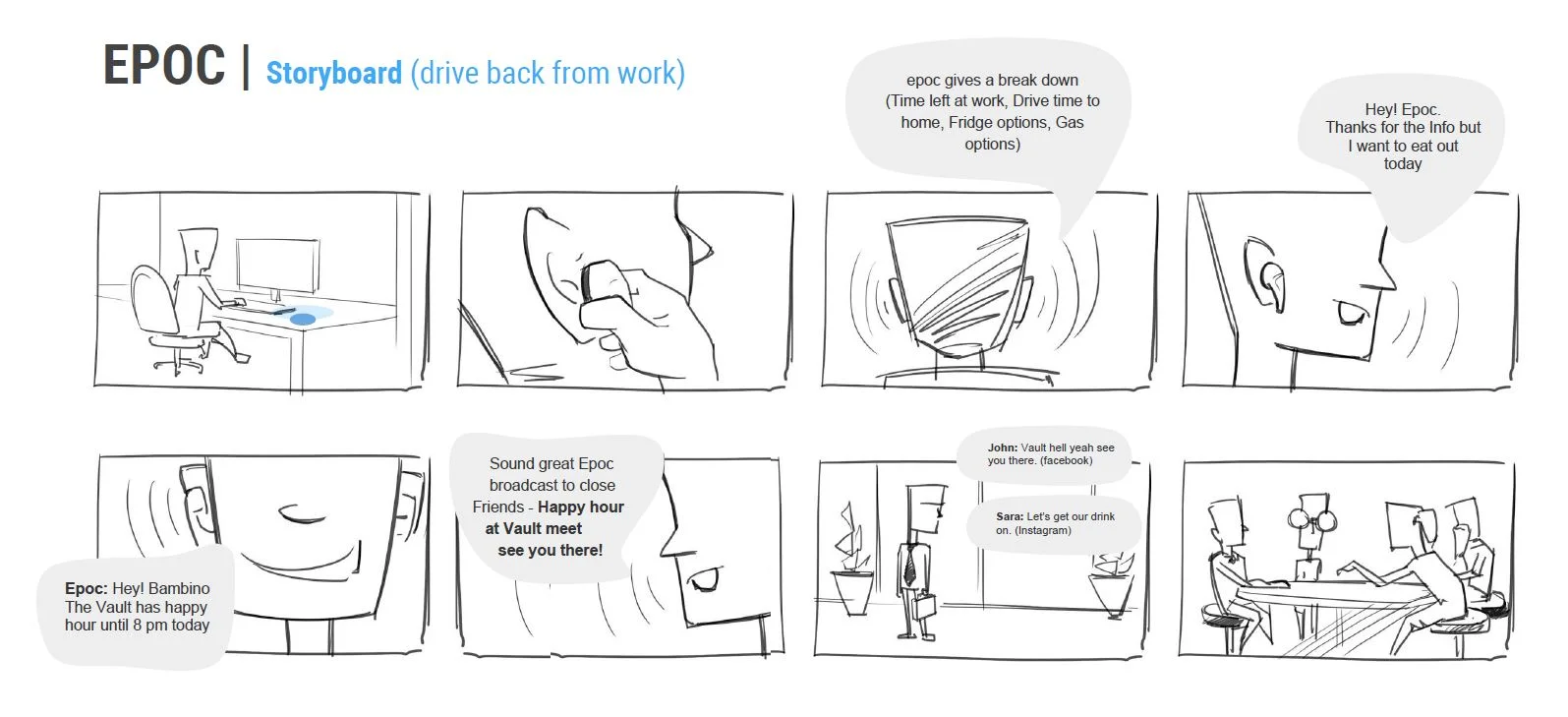
Storyboard (018, drive home): device gives breakdown (Time left at work, Drive time to home, Fridge options, Gas options). User: "Hey! Epoc. Thanks for the Info but I want to eat out today." Device broadcasts to friends: "Happy hour at Vault meet see you there!" Epoc: "Hey! Bambino The Vault has happy hour until 8 pm today." John (FB): "Vault hell yeah see you there." Sara (IG): "Let's get our drink on."
Comparative journey chart (019): red dashed "user guide" (unassisted) dips at pain points vs. green "Huic" and blue "epoc" lines staying smoother/elevated.
Section 4 — Wireframes & Usability Testing, Lo-Fi (slides 020–022)
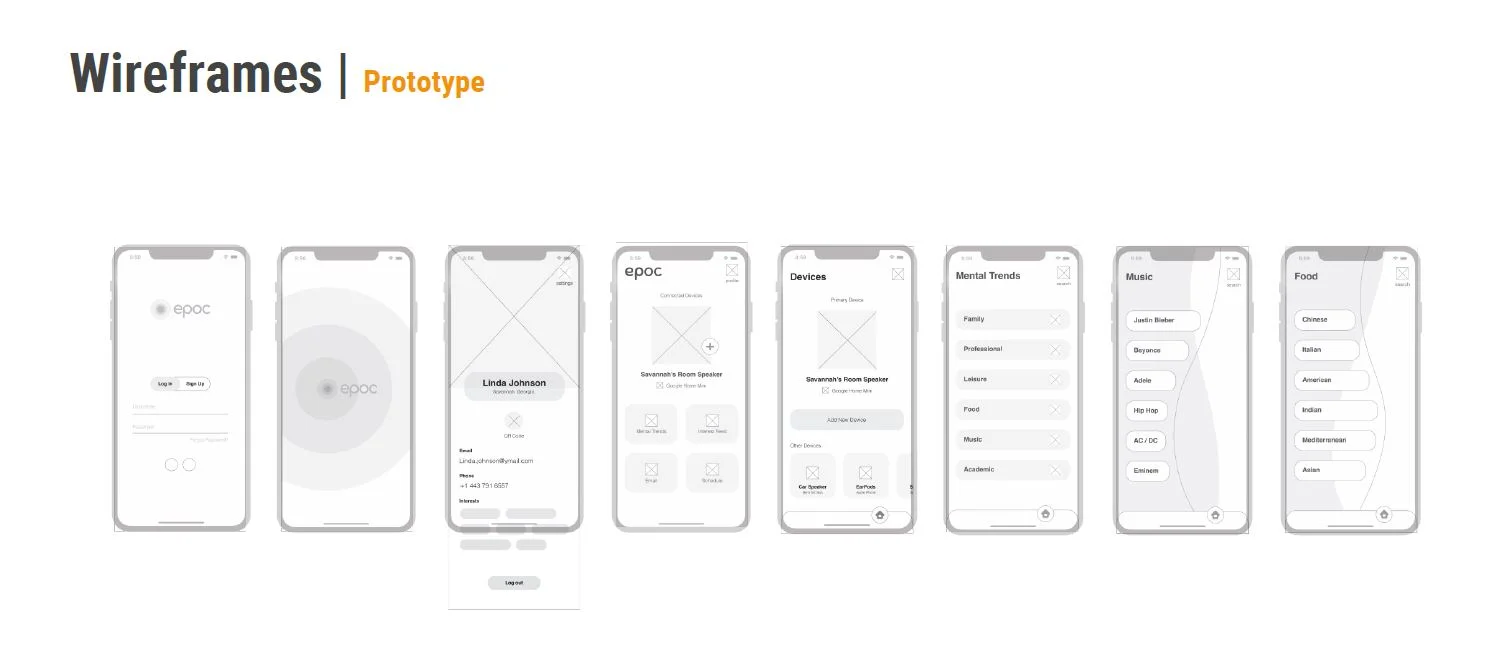
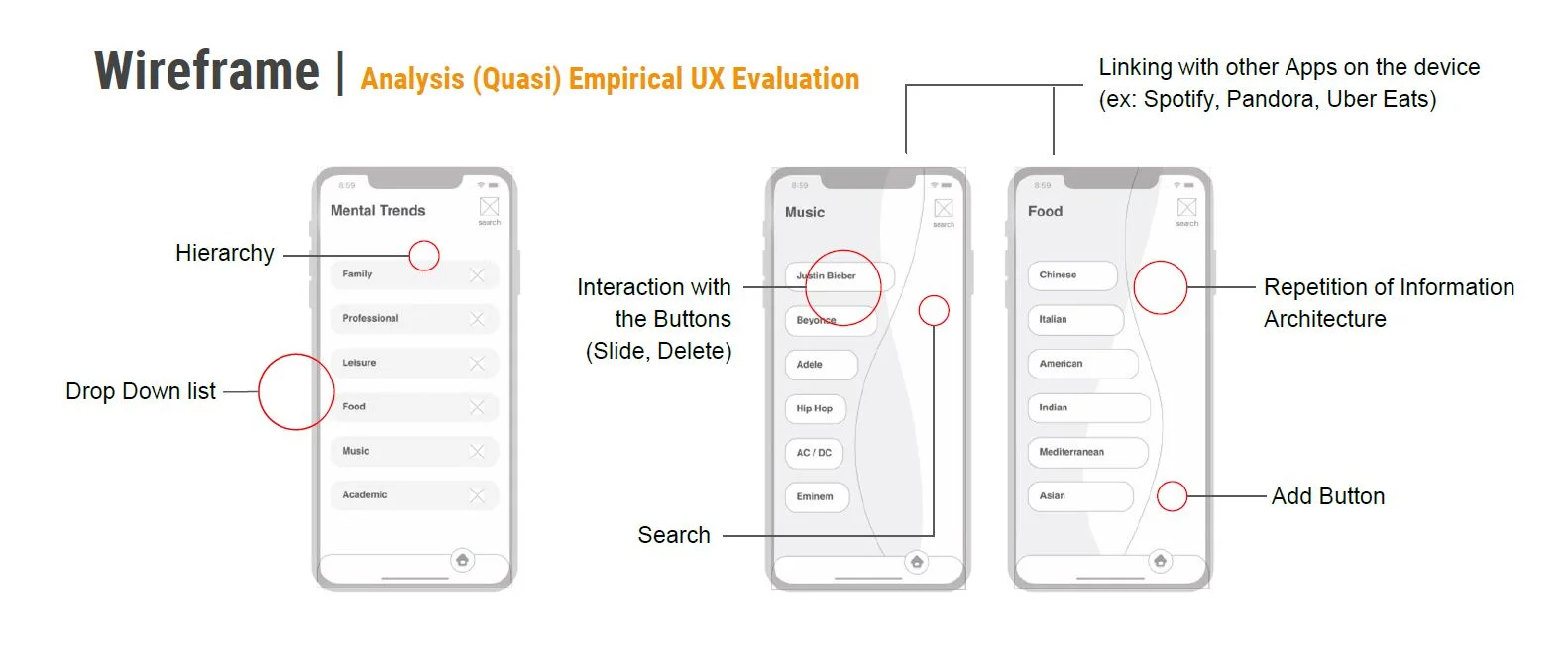 Login/Sign Up → Home (pulsing "epoc" icon) → Profile ("Linda Johnson," Off Grid toggle) → Devices compact (Savannah's Room Speaker / Google Home Mini) → Devices full (Add New Device, Car Speaker, Ear Pods) → Mental Trends list (Family, Professional, Leisure, Food, Music, Academic) → Music toggle chips (Justin Bieber, Beyonce, Adele, Hip Hop, AC/DC, Eminem) → Food toggle chips (Chinese, Italian, American, Indian, Mediterranean, Asian).
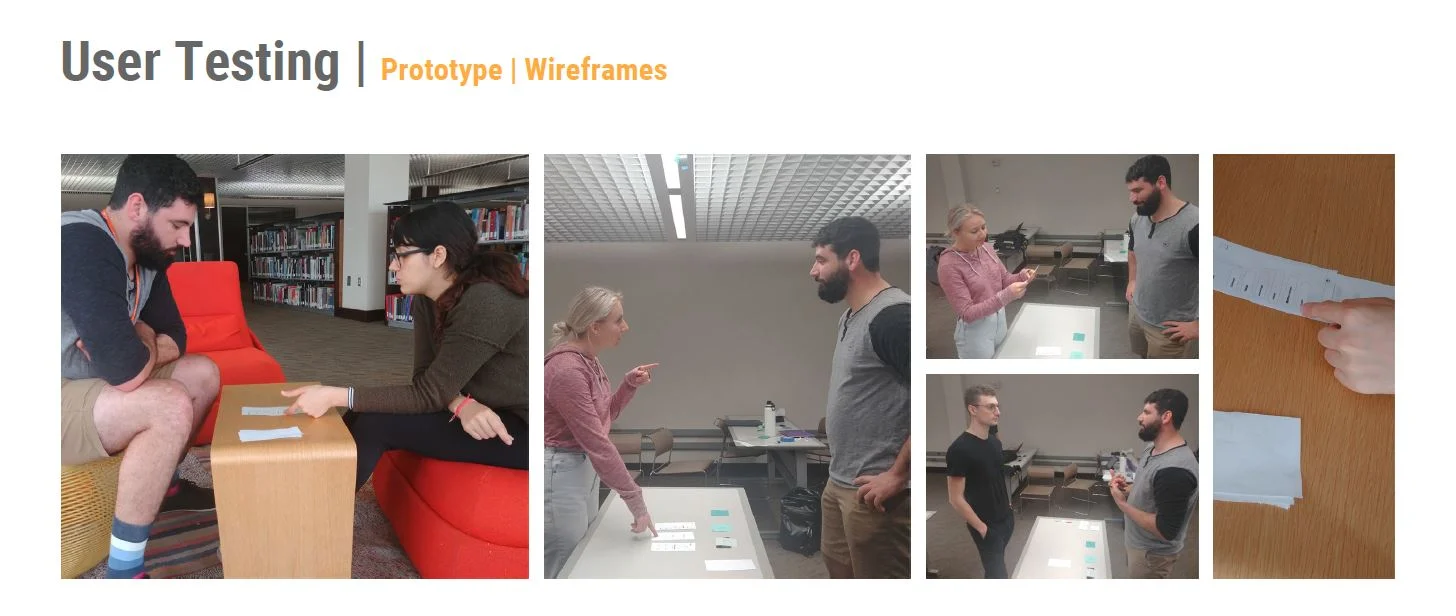
User testing photos (021): participants with paper/card wireframe prototypes, library setting.
Heuristic analysis callouts (022): Hierarchy, Drop Down list, Interaction with Buttons (Slide, Delete), Search, Linking with other Apps (Spotify, Pandora, Uber Eats), Repetition of IA, Add Button.
Section 5 — Final System: Device Network & Physical Prototype (slides 023–028)
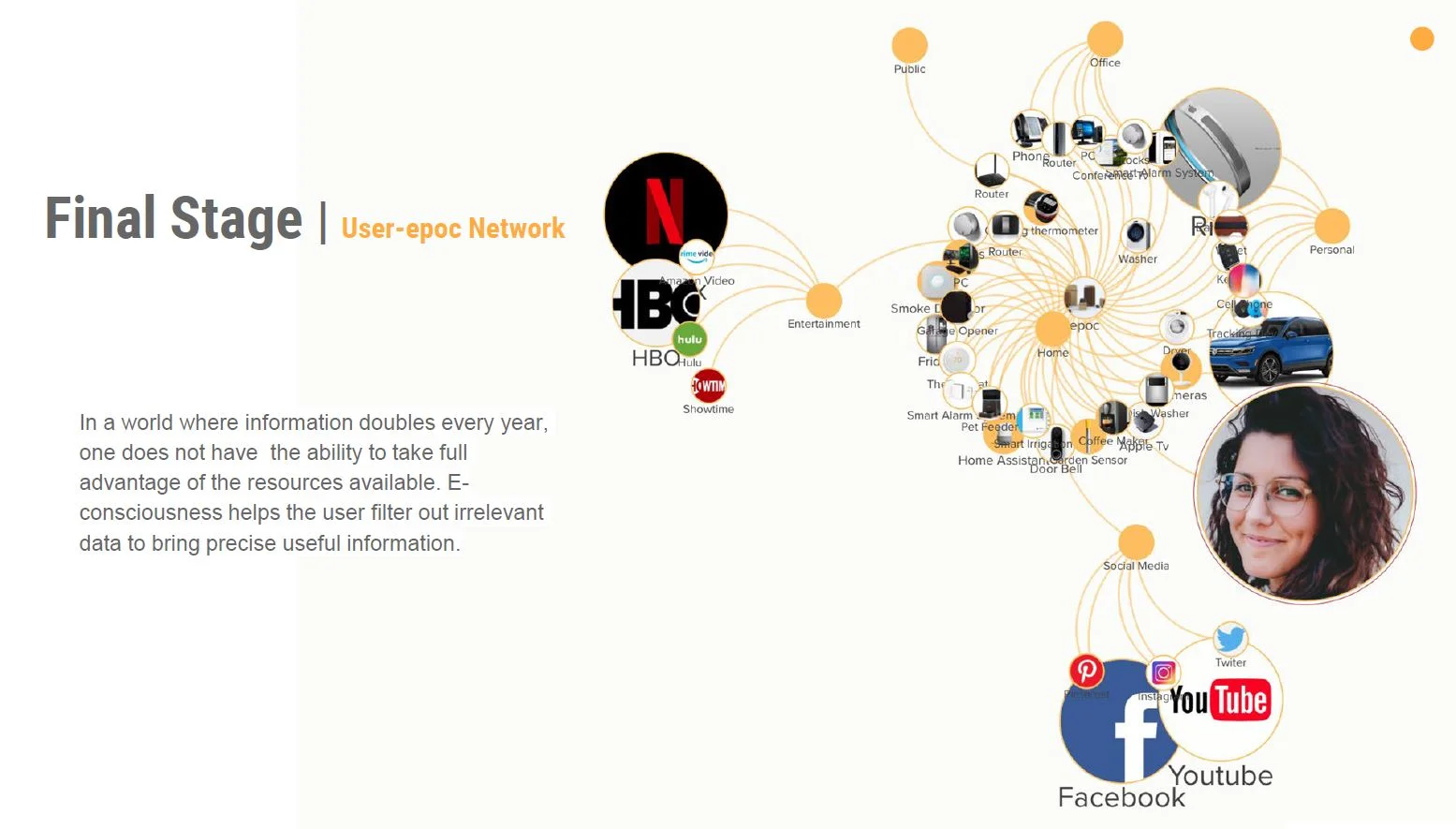
In a world where information doubles every year, one does not have the ability to take full advantage of the resources available. E-consciousness helps the user filter out irrelevant data to bring precise useful information.
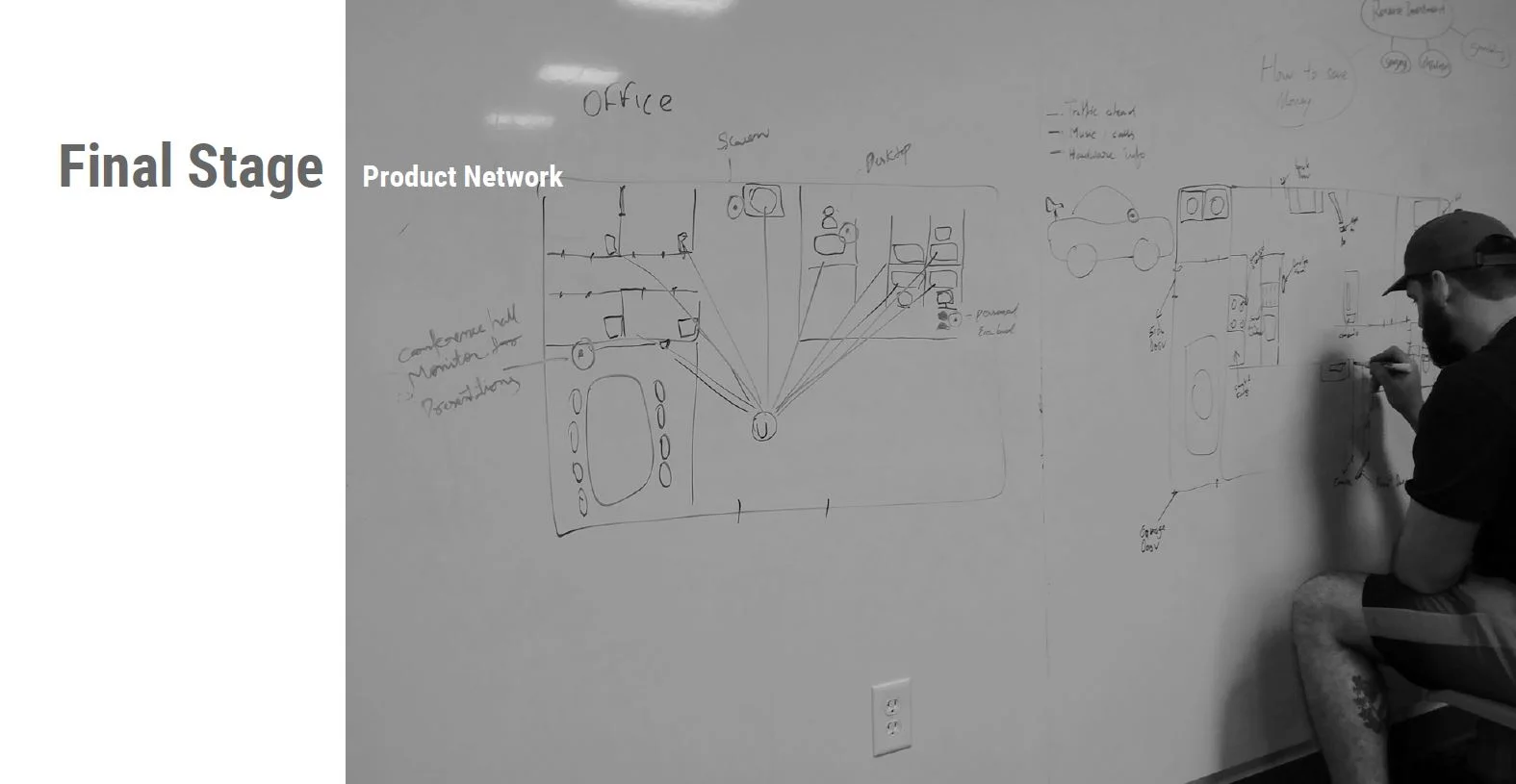
Whiteboard ideation photo (023): office IoT network sketch (screens, desktop, parking, conference monitors, door, presentations; traffic, music/calls, hardware info, garage sensors, "How to save money").
Radial hub diagram (024): "epoc" center, branches: Home (fridge, thermostat, alarm, garage, dishwasher, coffee maker, pet feeder, home assistant, garden sensor, doorbell, irrigation), Entertainment (Netflix, Amazon Video, HBO, Hulu, Showtime), Office/Public (router, PC, clocks, alarm, phone, conference tech), Personal (router, thermometer, washer, dryer, cameras, phone, keys, car tracking), Social Media (Pinterest, Instagram, Twitter, YouTube, Facebook).
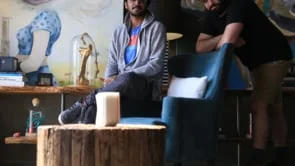
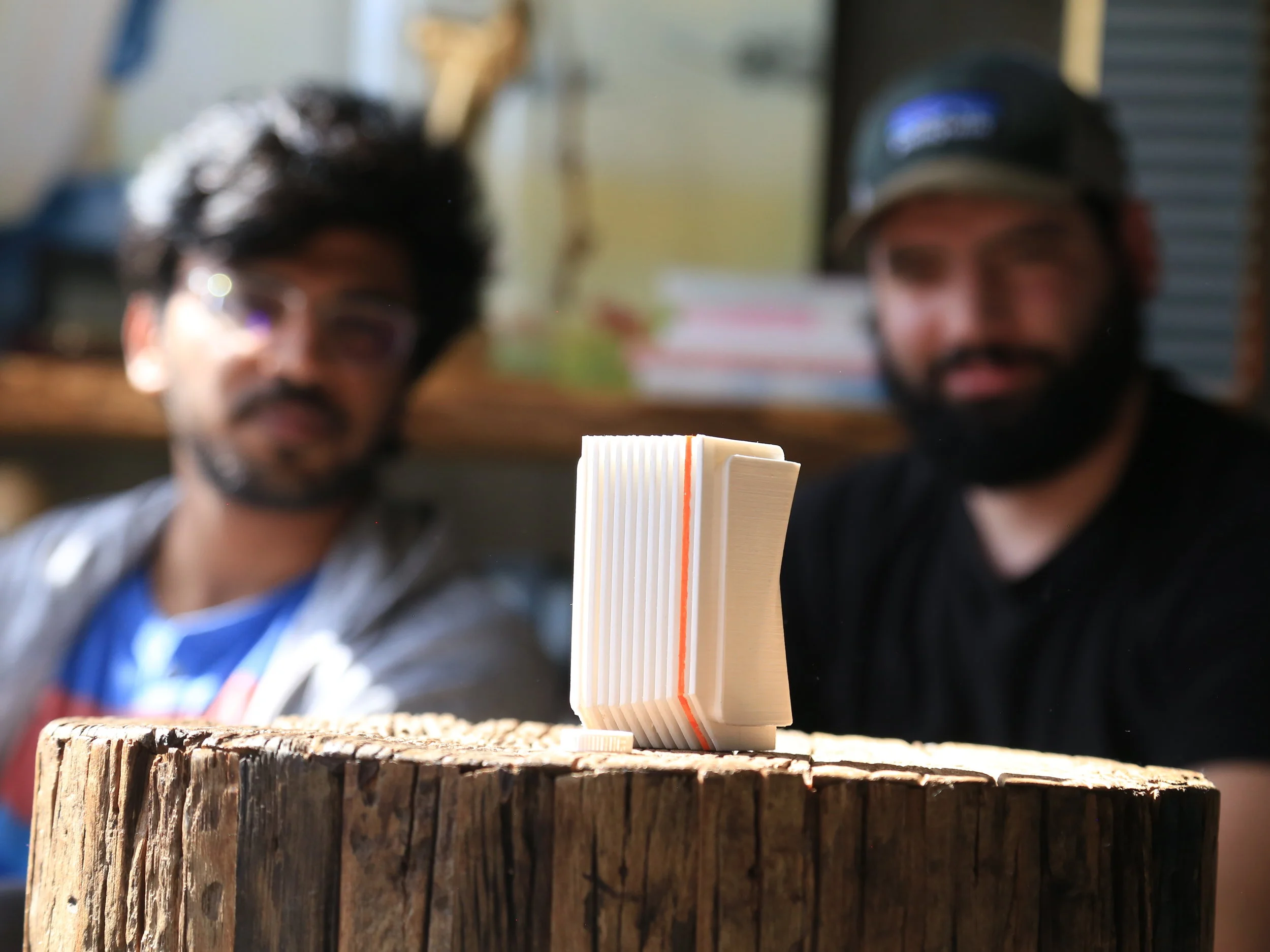
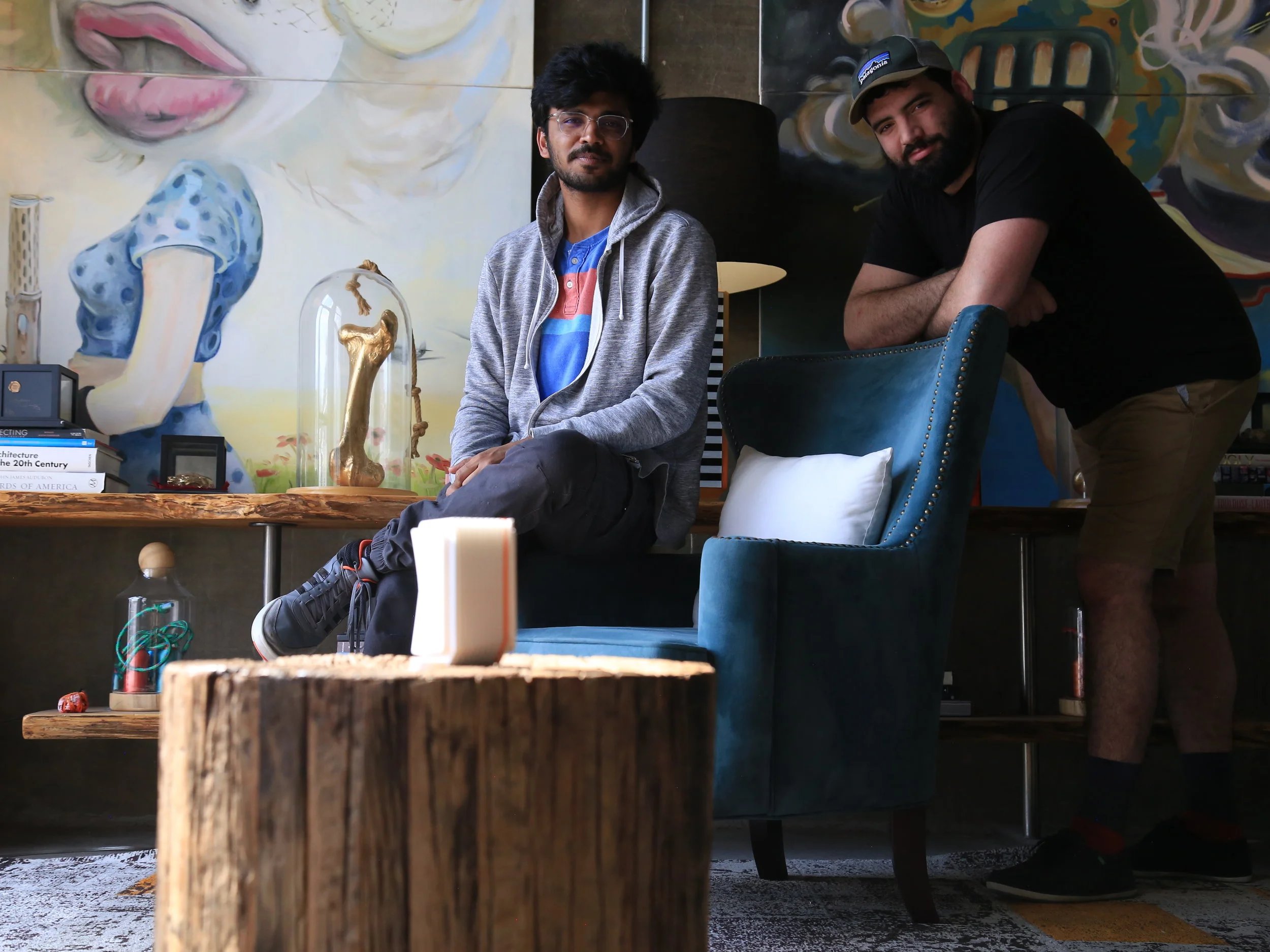
Physical prototype photography (025–026): 3D-printed pleated/ribbed white device with orange accent stripe, on a wood stump, two designers visible in background (loft/workshop).
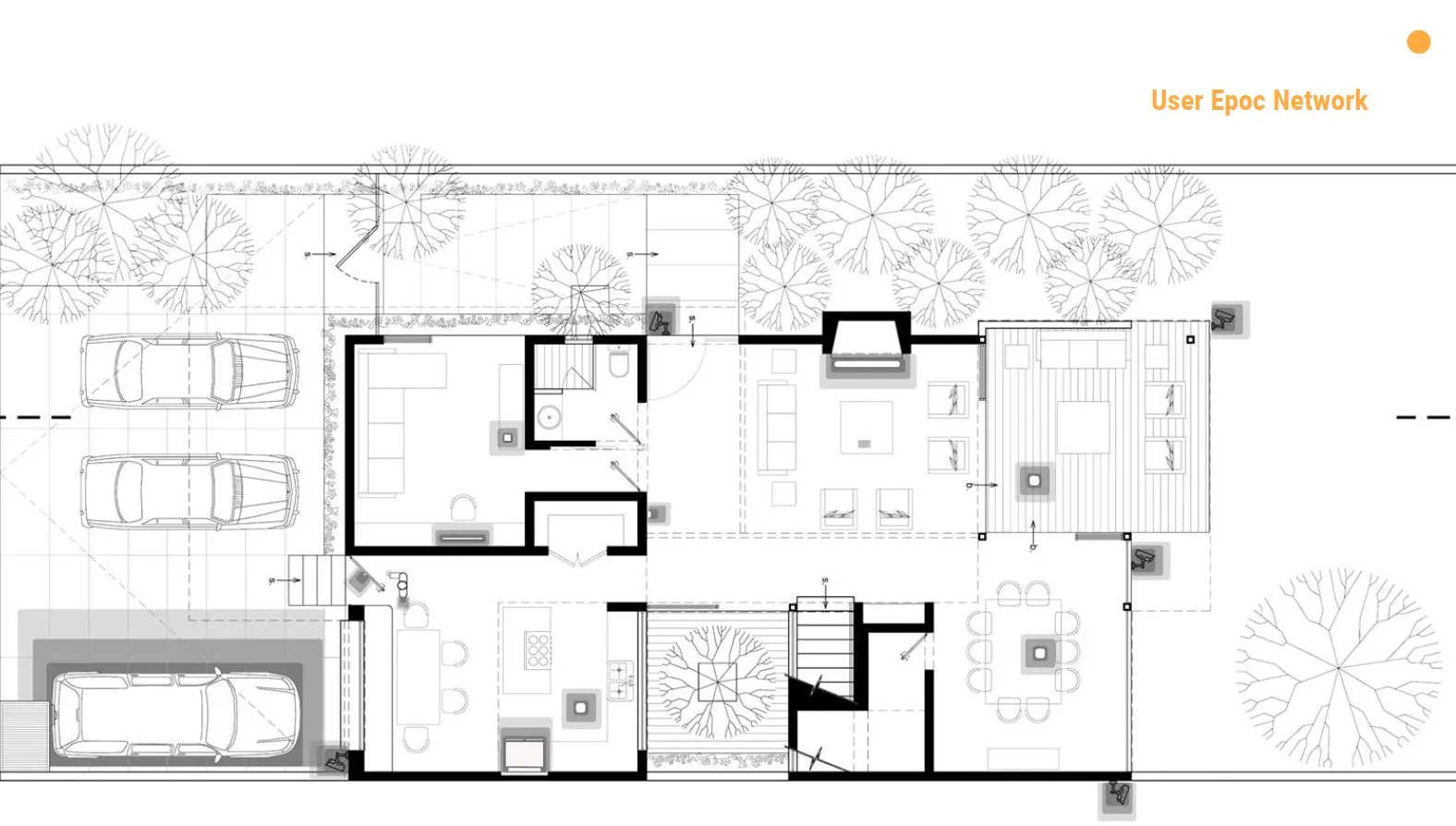
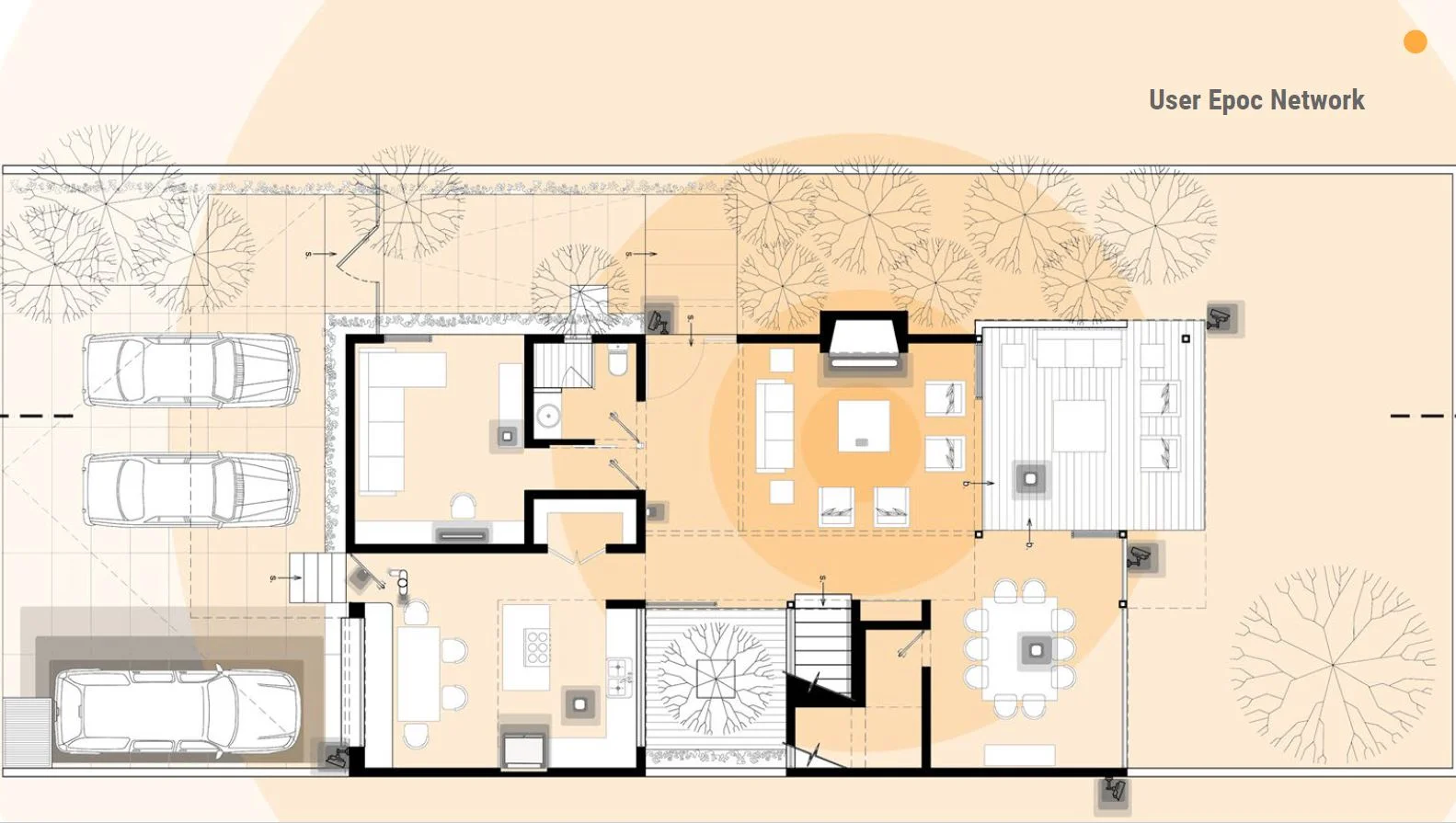
Floor-plan visualizations (027–028): top-down house plan with sensor/camera/speaker icons at doors, deck, garage, living spaces; 028 adds an orange radial heat-map overlay from the living room showing signal/presence coverage.
Section 6 — Hi-Fi UI & Final Presentation (slides 029–030)
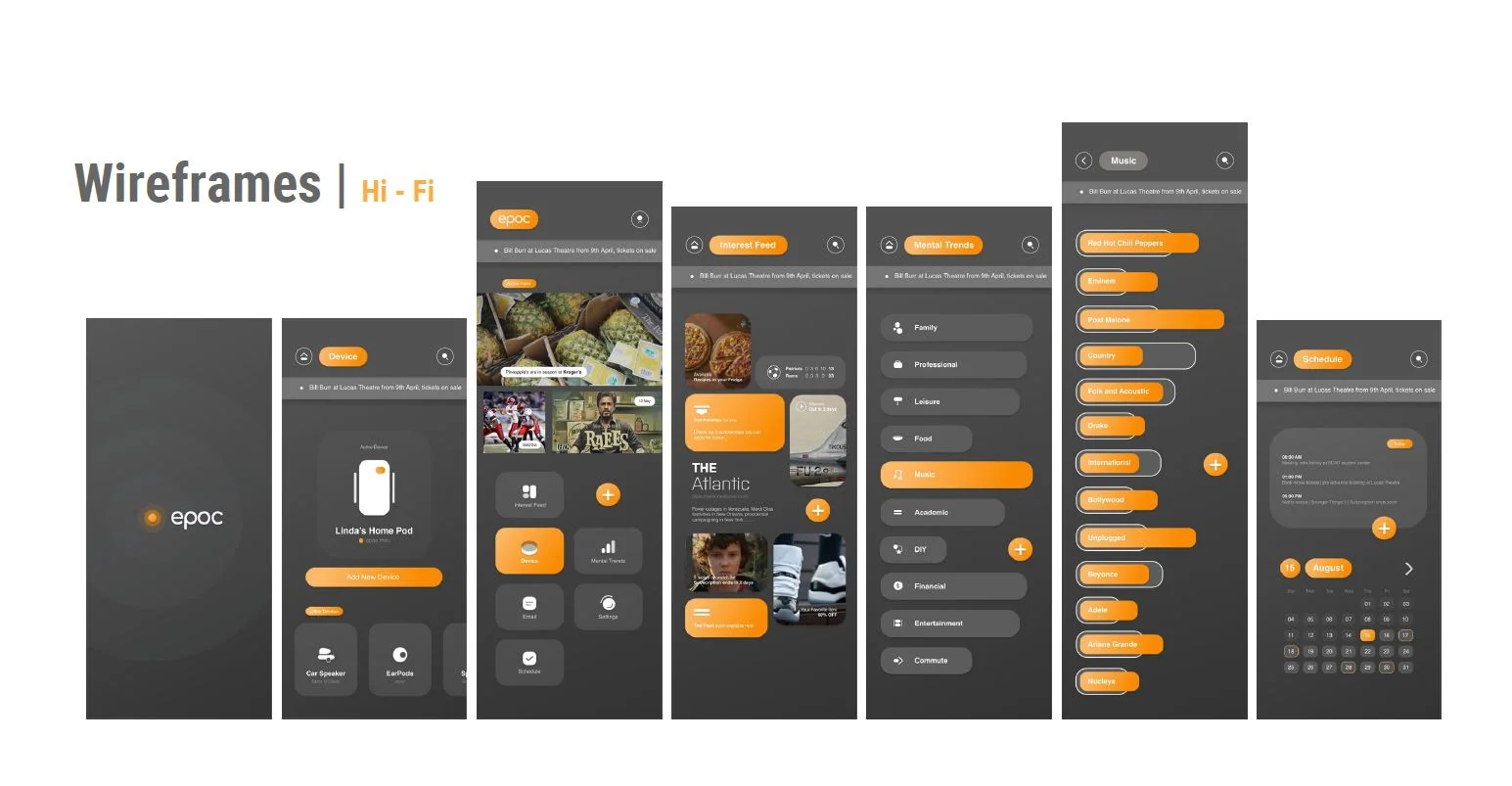
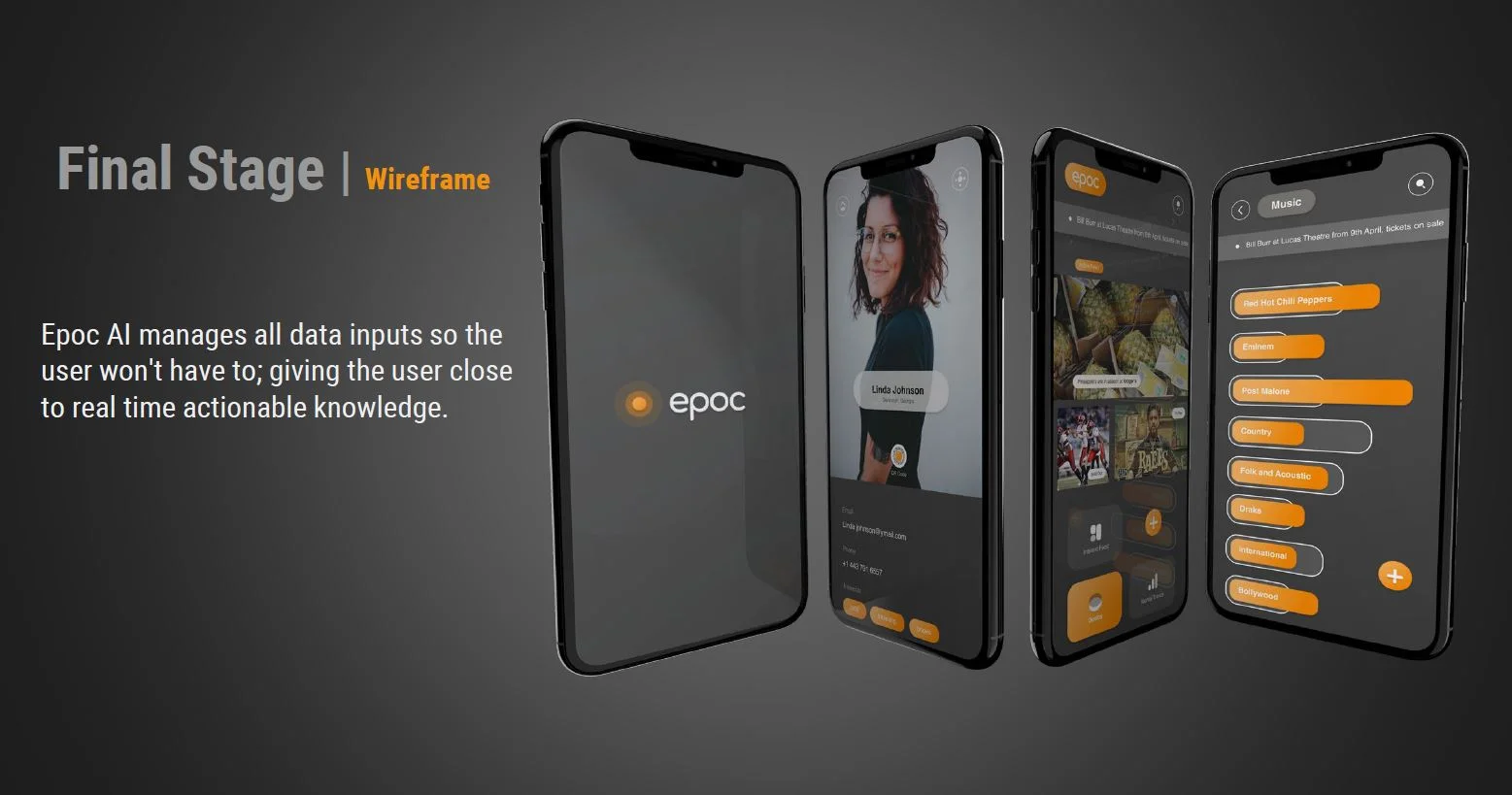 Dark charcoal/orange hi-fi screens: Splash (pulsing logo) → Device (Linda's Home Pod, Add New Device) → Home feed (notification banner "Bill Burr at Lucas Theatre from 9th April, tickets on sale," content cards) → Interest Feed (The Atlantic piece, grocery/sports/travel cards) → Mental Trends (Family, Professional, Leisure, Food, Music [selected], Academic, DIY, Financial, Entertainment, Commute) → Music (long chip list: Red Hot Chili Peppers, Eminem, Post Malone, Country, Folk and Acoustic, Drake, International, Bollywood, Unplugged, Beyonce, Adele, Ariana Grande, Nucleya) → Schedule (August calendar, day-agenda list).
Hero tagline (030): "Epoc AI manages all data inputs so the user won't have to; giving the user close to real time actionable knowledge." — strongest candidate for site hero copy.
Section 7 — Validation: In-Drive User Testing (slide 031)
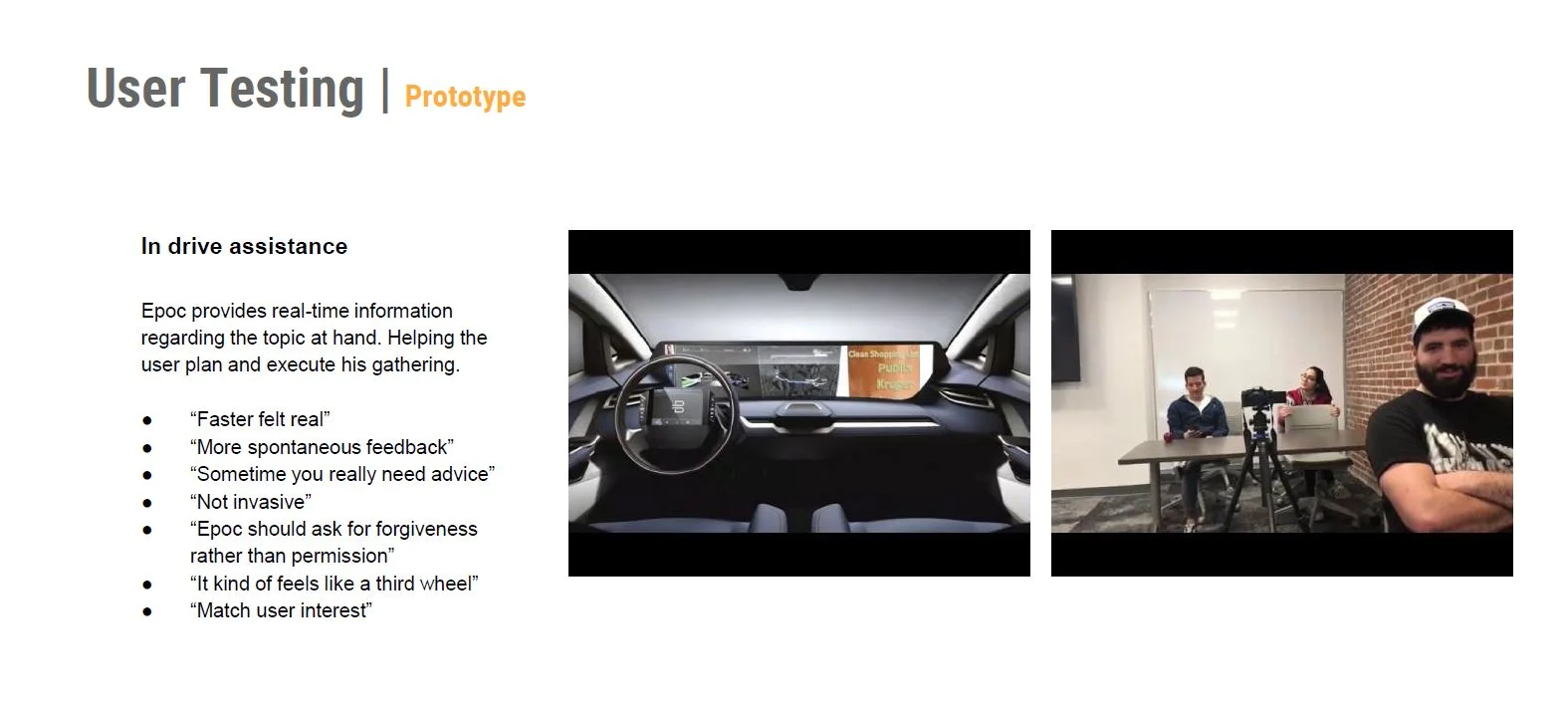
Epoc provides real-time information regarding the topic at hand. Helping the user plan and execute his gathering.
User quotes: "Faster felt real" / "More spontaneous feedback" / "Sometime you really need advice" / "Not invasive" / "Epoc should ask for forgiveness rather than permission" / "It kind of feels like a third wheel" / "Match user interest"
Visual: in-vehicle HUD concept ("Clean Shopping List — Public Kroger" notification), documentary photo of user-test session.
Section 8 — Credits (slide 032)
 epoc logo (orange gradient dot + gray wordmark), caption "Noel Gonzalez | Rithesh Rama." Likely works better as a footer/attribution line than literal sequence position.
Section 9 — Final Industrial Design Render (slide 034, "box layout")
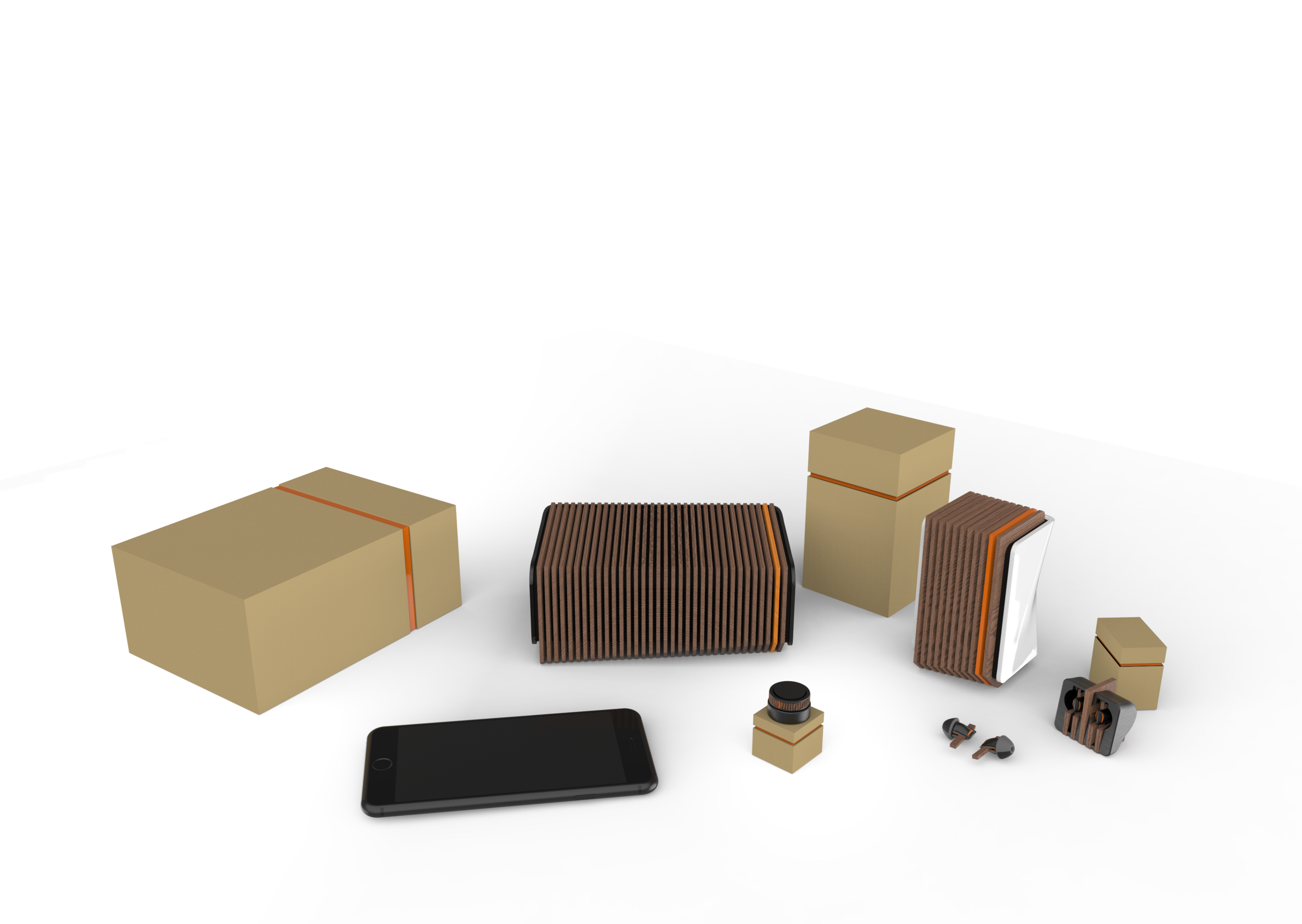 3D render: kraft shipping box with orange strap; fully-assembled device (closed shell + exploded/open view with orange gasket seam); smaller charging-accessory box; blank iPhone for scale; round charging puck/cap; two earbud-like components with two-pronged charging cradle. Strong closing visual.
Flags for the rebuild
- Slide 004 ("Expected outcome") appears before any research — intentional 4-slide executive summary, not literal chronology; its early concept art differs from the final design in slide 034.
- "Huic" vs "Epoc" is a real naming-evolution story (could be told explicitly), not an error — slides 011–014 largely duplicate content rebranded in 015–019.
- Typos preserved verbatim from source: "Phyco-Aesthetic Map," "plannign," "washes a TV show" (likely "watches"), raw survey typo "wastw."
- Slide 032 (credits) likely works better as closing/footer attribution than literal sequence position 32 of 34.
- Slide 033 is a low-res duplicate/crop of slide 026 — skip it, use 026 full-res instead.
- Unlabeled woman's photo on slide 024's network diagram — identity/purpose unclear, confirm before reusing.
- Red circle on "2001" in the history timeline (005) has no caption — purpose unclear.
- Stats ("54%," "90%" etc. in the journey map) have no cited source in the deck.
Additional process photos