Graey Space
A modular storage system for clothes worn but not yet ready to wash
Source: squarespace-export/images/new-project-1/001.png–017.jpg (17 slides — a curated highlight reel from a larger original deck; original filenames reference presentation slides -10, -12, -13, -14, -19, -33, -34, implying 34+ original slides).
Suggested title & subtitle
Title: Graey Space Subtitle (not a verbatim quote — the deck has no written problem statement): A modular, flat-pack felt storage system for the clothes that are worn but not dirty enough to wash yet.
Important note: across all 17 slides there are only three lines of real sentence-level text (slides 008–010). Everything else is diagrams, sketches, dimensioned drawings, or styled photography with no captions — descriptions below of wordless slides are inferred from the visuals, not transcribed text.
Problem / Context (slides 001–006, no text — inferred from visuals)


- 001: Row of 7 shirt icons with color-coded dividers (green → olive → orange → red), shirts getting more wrinkled toward red — reads as a "freshness gradient" of clothing moving from clean toward needing a wash.
- 002: Icon sequence: washer+dryer → closet rail → wearing → folded pile on a chair → wearing again → laundry hamper — the everyday clothing-use cycle.

- 003: Same sequence as 002, but the "folded pile" step is replaced with a twisted/coiled fabric bundle — a meaningful pivot, visually anticipating the coiled felt product shown later (the design insight: people twist/toss worn clothes into informal piles — what if storage embraced that shape?).

- 004/005: Hero photo (landscape + portrait crop) — a hand-decorated white ottoman overflowing with colorful worn clothing against a bright green background. "A pile of clothes that have nowhere designated to go."


- 006: Styled photo of the actual coiled-felt product prototype on a wooden tripod stand, teasing the solution.
Ideation / Design Process (slide 007)
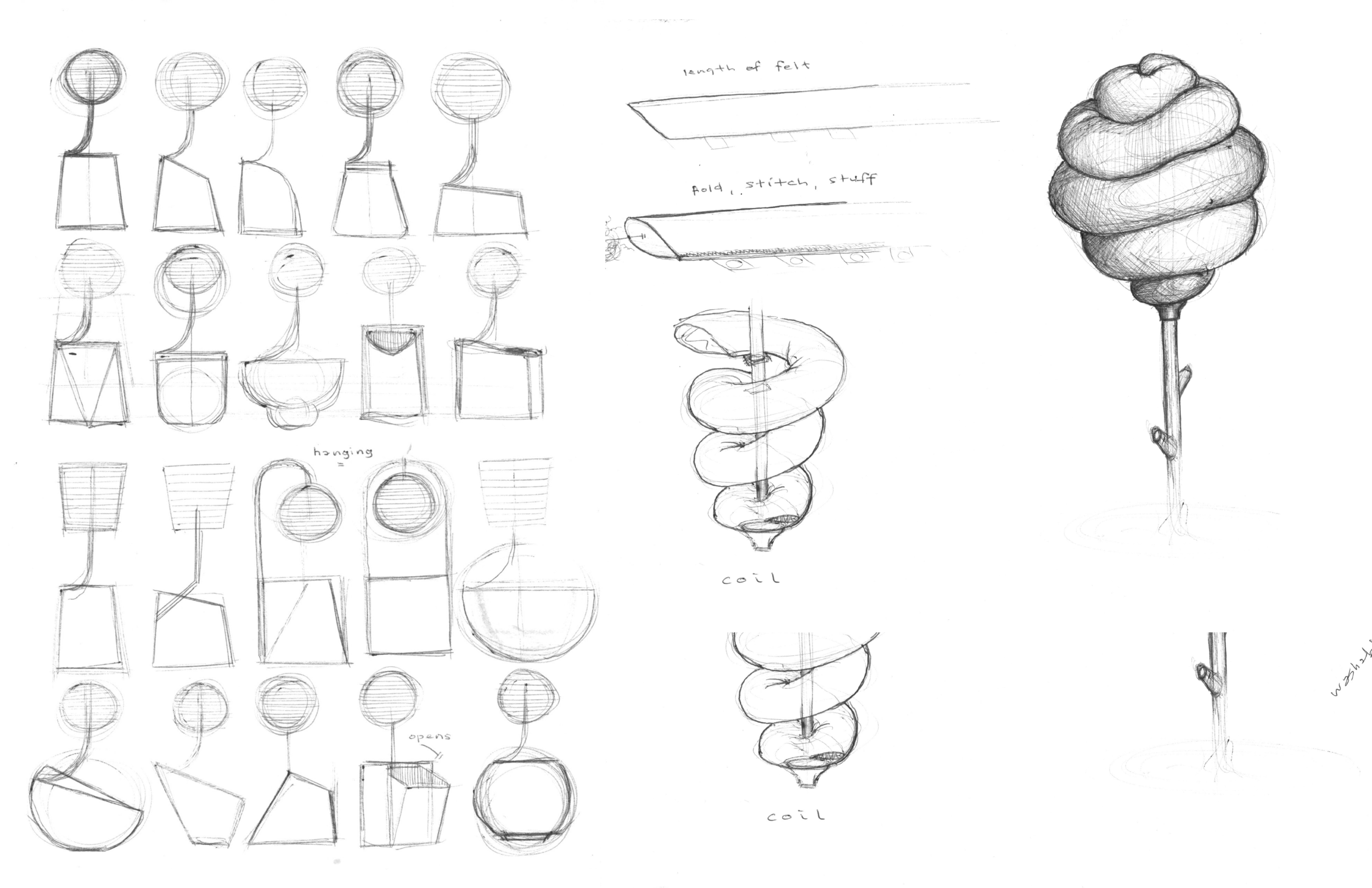 Single sketch sheet, three panels:
- 4×5 grid of "ball-on-a-post" form explorations (sphere/head atop different base shapes), two annotated "hanging" and "opens."
- Construction diagrams: a felt strip labeled "length of felt" → "fold, stitch, stuff" → "coil" (spiral-wound around a central dowel to build the stacked-donut form).
- Large refined pencil rendering of the finished coiled-felt column on a thin post — the final design direction.
Solution / Product Design (slides 008–012)
Flat Pack Furniture (slide 008)
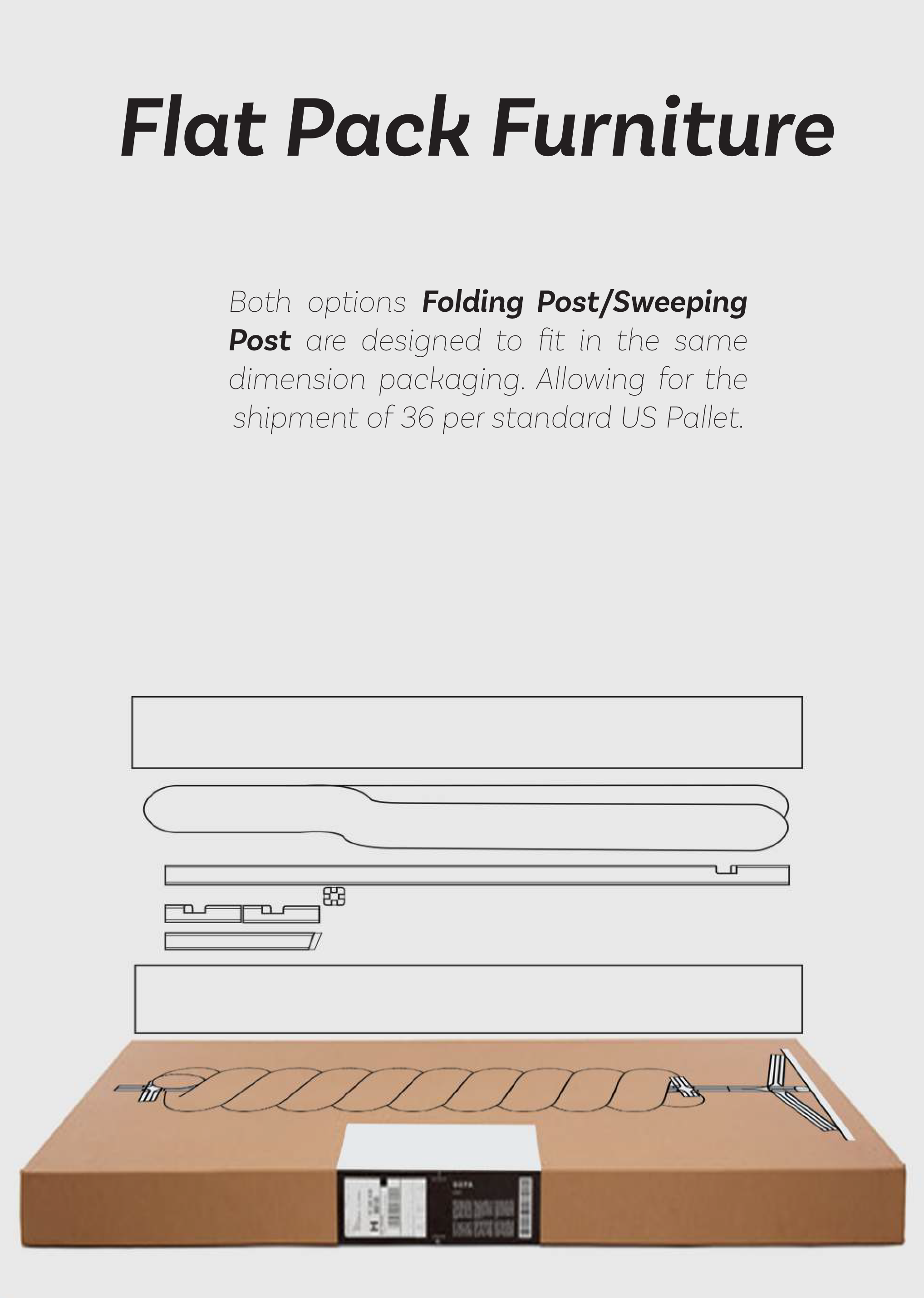
"Both options Folding Post/Sweeping Post are designed to fit in the same dimension packaging. Allowing for the shipment of 36 per standard US Pallet."
Diagram: exploded flat-pack packaging — box outline, flattened/uncoiled felt strip, pole with notched joinery and hardware, nested into an isometric shipping carton with barcode — shows DTC packaging/logistics thinking (pallet shipping efficiency).
Folding Post (slide 009)

"A solution for the casual every Items and Graey Space clothe" (sic — likely meant "casual everyday items")
A felt object made of multiple open-ended cone/petal shapes on a wooden cross-foot base, pink background, pale pink clothing tucked into the petals, canvas sneakers nearby for scale. The shorter, multi-cone variant for frequently-worn "everyday" items.
Sweeping Post (slide 010)

"A solution for the casual weekly Items and Graey Space clothe" (sic — same grammatical issue)
The taller, single continuous coil variant: full-height coiled felt column, ball caps on top peg, shirts draped over the coils, standing on a skateboard deck against a blue background — a more casual/streetwear styling. Positioned as the solution for items re-worn across "the casual weekly" cycle.
Product system / exploded diagram (slide 011)
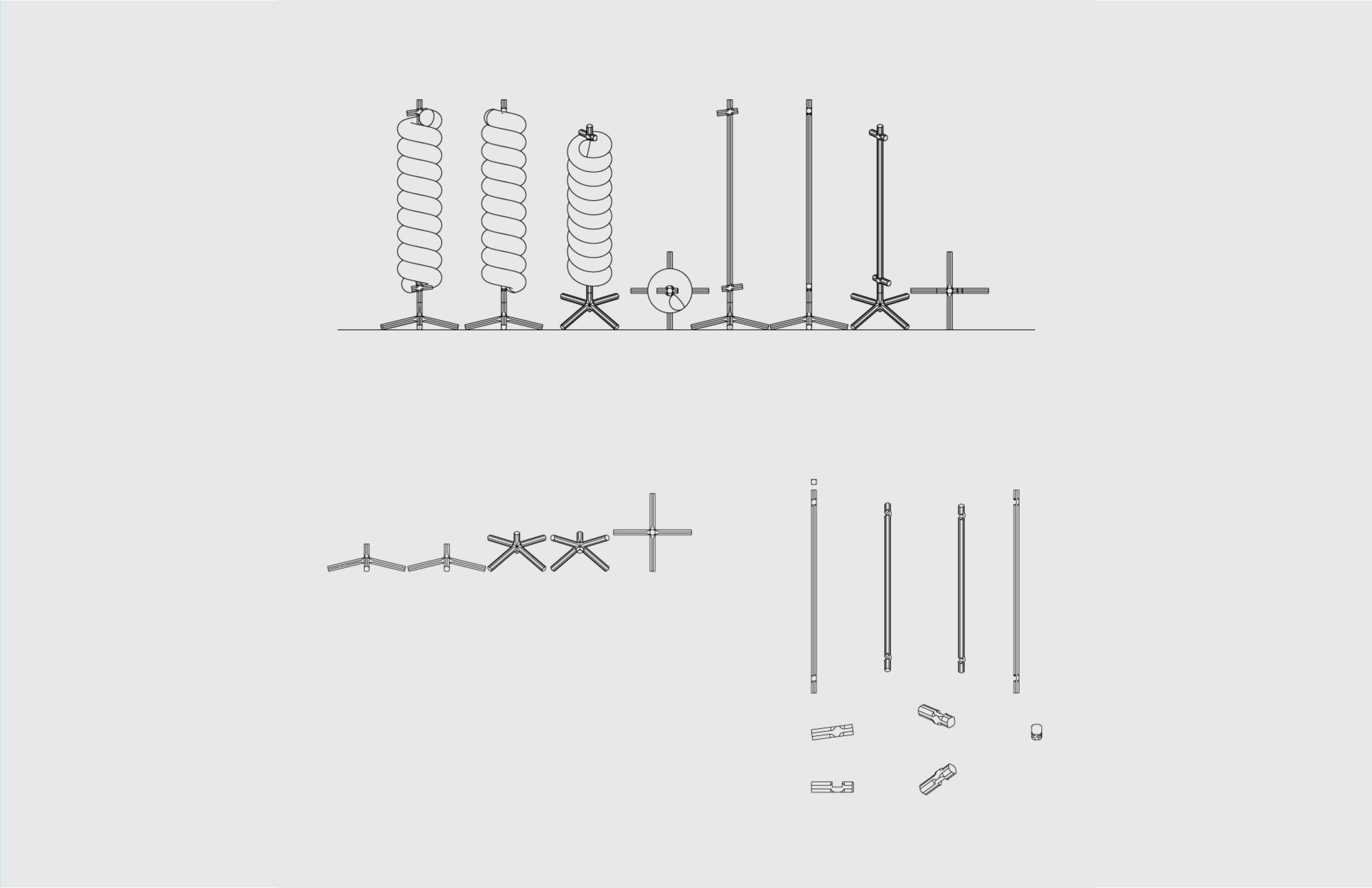 No text. Technical line drawing: product-family lineup (coil-topped posts and straight-pole-topped posts on tripod-leg or cross bases, varying heights) plus exploded component views (joint pieces, cross/4-arm base, pole segments with joinery hardware) — a modular kit of interchangeable parts.
Dimensioned specifications (slide 012)
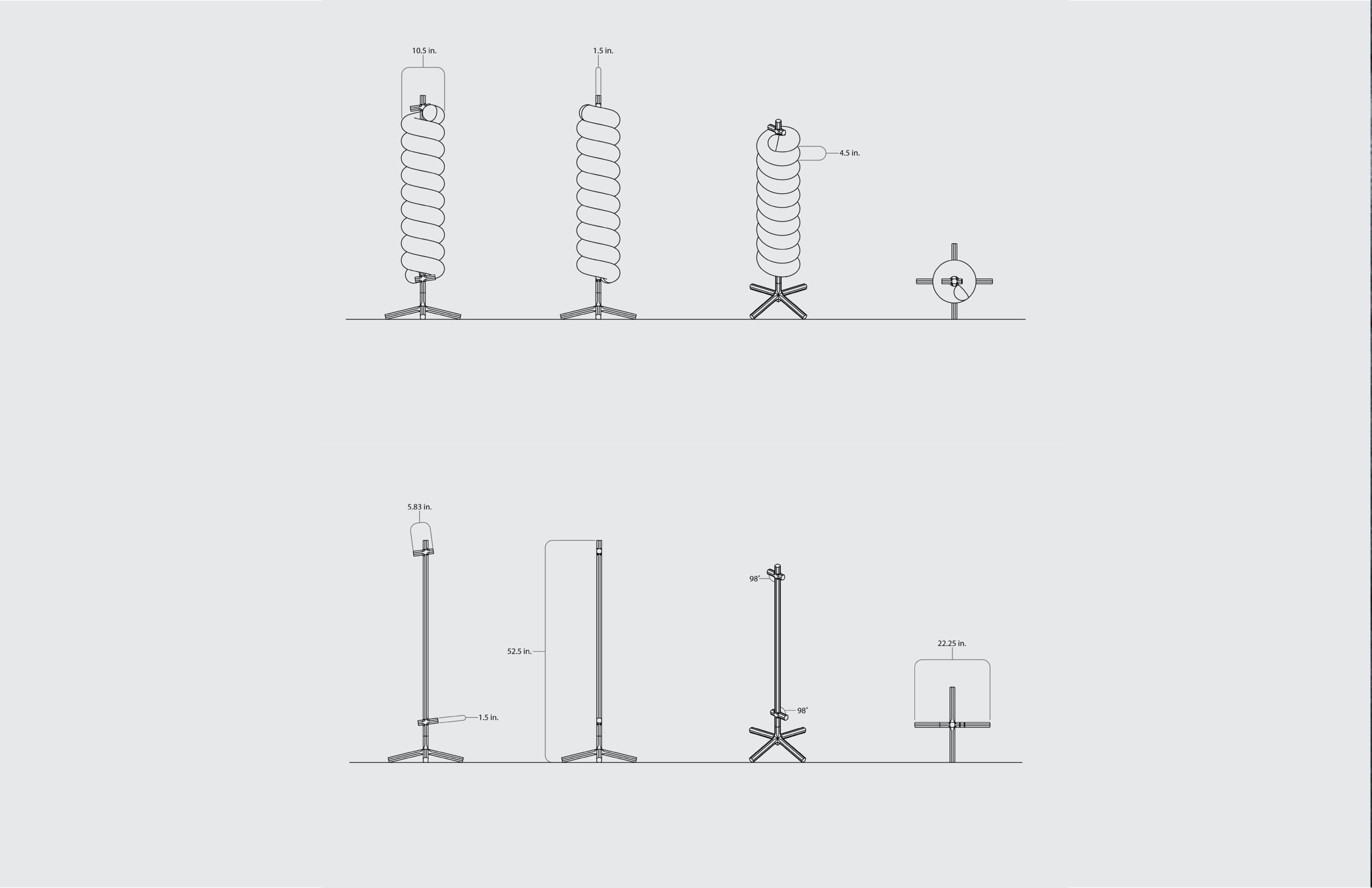 Numeric callouts only: 10.5 in. / 1.5 in. / 4.5 in. (coil variant heights); 5.83 in. / 1.5 in. (pole piece + base dowel); 52.5 in. (tall panel/pole height); 98° (joint angles, appears twice); 22.25 in. (width of a side shelf/tray attachment). A manufacturing spec sheet for the component variants.
Final Product Photography (slides 013–017, no text)
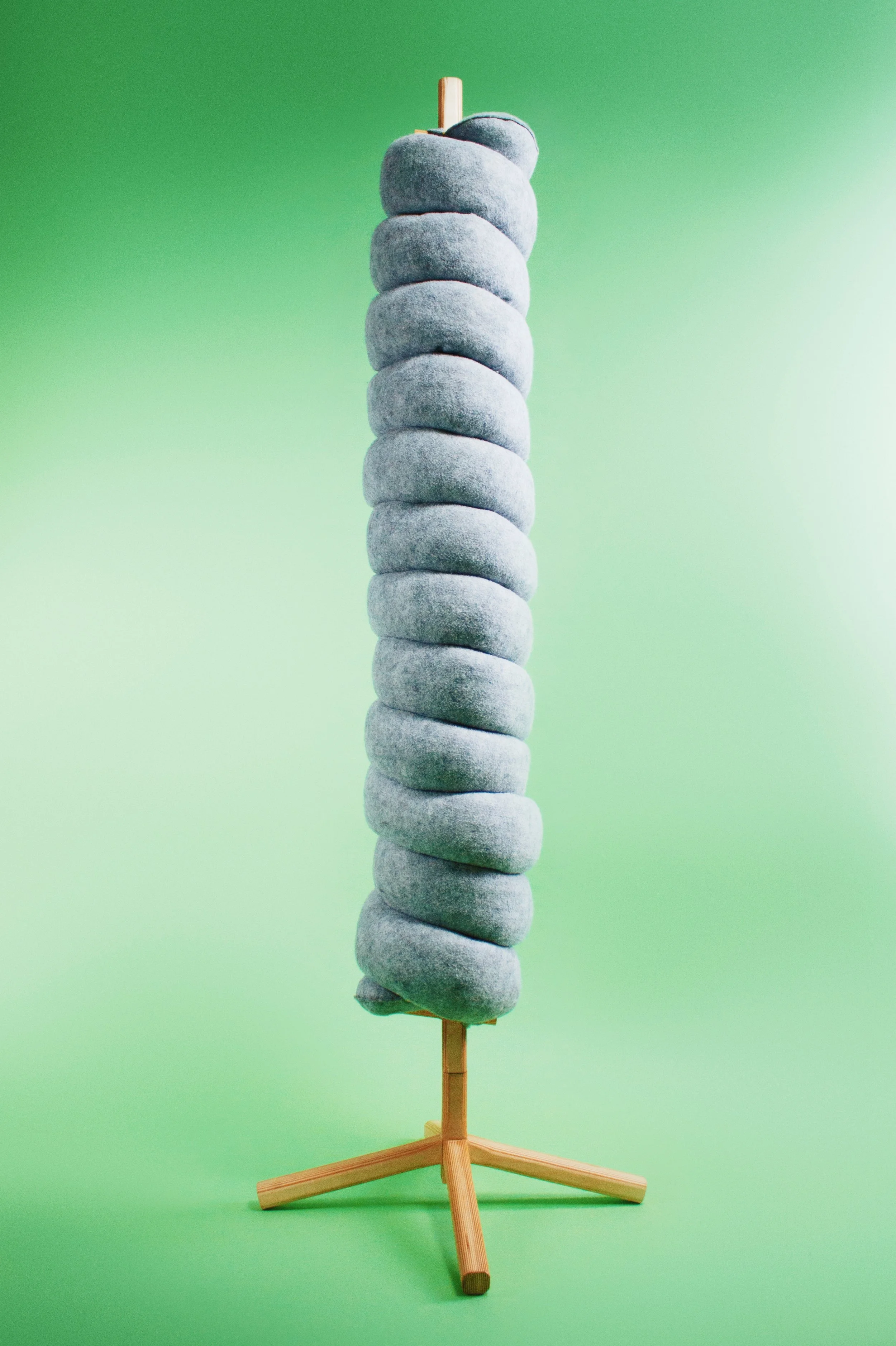

- 013: Clean studio shot of the Sweeping Post alone on a green background.
- 014: Close detail of garments (bandana, socks, cardigan, floral shirt) tucked between the coil ridges — showing how the gaps catch and hold garments without hangers.

- 015: Lifestyle shot — Sweeping Post dressed with a cardigan, towel, and floral shirt, staged next to a vintage metal chair and potted palm.

- 016: Tight detail of the wooden tripod base/foot joinery.

- 017: Tight detail/lifestyle crop of the coil's upper portion, draped with a cardigan, t-shirt, and plaid shirt.
Flags for the rebuild
- No written problem statement anywhere — the "why this product exists" argument is carried entirely by wordless icon diagrams and a styled photo. The developer will need to write original framing copy or present this section as a wordless mood board.
- Garbled taglines on slides 009 and 010 — both read "...casual every Items and Graey Space clothe" / "...casual weekly Items and Graey Space clothe." These look like unfinished edits (missing a word after "every," "clothe" singular where "clothes" is likely intended) — flag before publishing as-is.
- Illegible handwriting on slide 007 — a short scrawled word/signature near the bottom-right of the large coil rendering couldn't be read with confidence.
- Slides 004 and 005 are the same photograph (landscape + portrait crop) — functionally a duplicate, likely exported twice for responsive layout use on the original site.
- No visible section explicitly labeled "Research" or "Outcome/Results" — the four-part structure above (Problem/Context → Ideation → Solution/Design → Final Photography) is inferred from slide ordering and content type.
- This is a curated excerpt, not the full original deck — original filenames reference presentation slide numbers up to at least 34, so the published site only ever showed a subset. If the user has the original full presentation file, there may be additional written research/problem content that never made it onto the Squarespace page.
- Diagrams 001–003 and 011–012 have no captions — any descriptive copy written to accompany them on the new site should be understood as new writing, not transcription.