Meal Assistant
Two studies, one adoption story — Kroger / Cooklist
Source: live page text at /meal-assistant/ (was password-protected, unlocked by user).
Subtitle
"How trust, realism, and plan-to-cart reliability shape weekly meal planning behaviors."
Why Two Studies
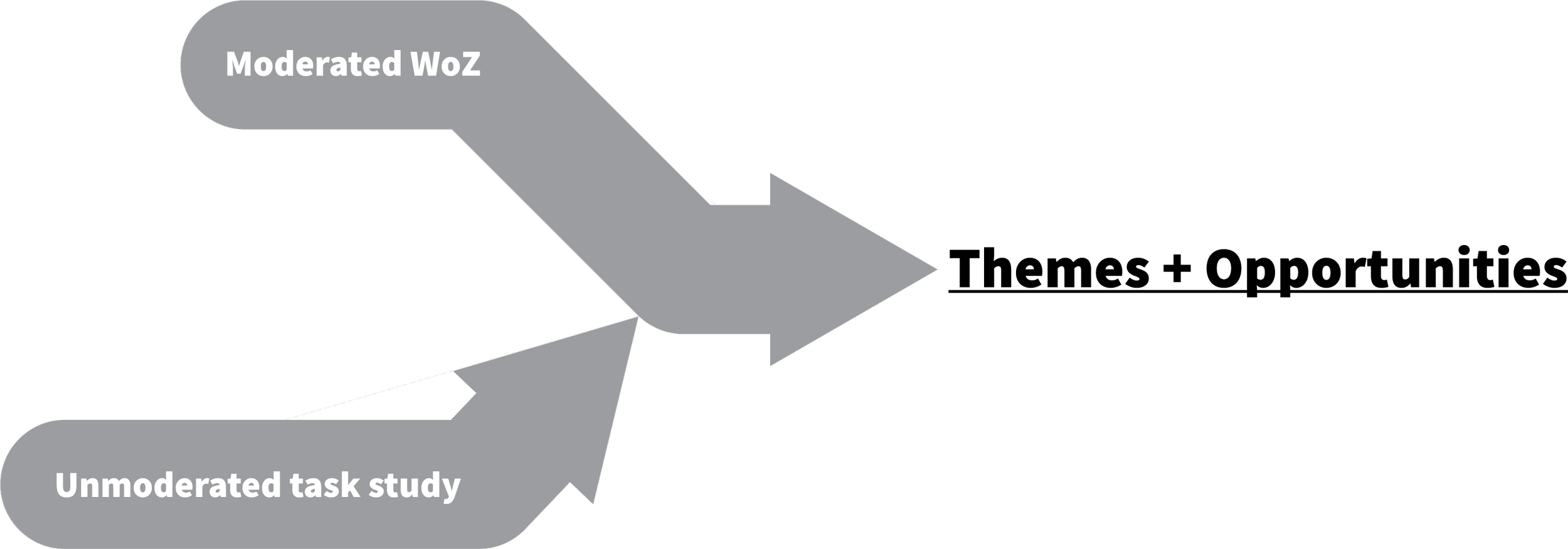
One study explores motivations (diagnostic); another examines breakpoints across the complete workflow (coverage). Together they identify barriers and requirements.
Moderated Wizard-of-Oz Interviews
Method: 60-minute Zoom sessions where participants interacted with a simulated assistant; a researcher controlled the "system" behind the scenes using predetermined response patterns, to test UX before full development. Sample: N=5 Goal: Compare traditional vs. AI-assisted meal planning for speed, confidence, and trust.
Themes from the Wizard
- Recipe-Centric Experience — Recipes must remain the focal point through shopping and checkout; losing recipe visibility erodes confidence.
- Automation with Control — Users value automation for heavy calculations but demand visible choices: substitutions, brand options, override points.
- Transparency Builds Trust — Users need to understand why specific brands, quantities, and prices were selected and how savings were calculated.
- Persistent Personalization — The system should remember dietary rules, household size, and budget across sessions rather than requesting repeated input.
- Continuity and Reusability — Customized plans should be easily saved and reused; users want to build a personal digital cookbook over time.
- Safety and Explainability — Users accept sharing practical constraints when purpose is clear; they want plain-language reasoning behind suggestions.
- Tone and Trust Signals — A warm, collaborative tone — like a supportive cooking partner — establishes trust through transparency and control.
- Ads as Value, Not Noise — Ads are acceptable only when aligned with user goals like savings; generic ads undermine trust.
Opportunities from the Wizard
- Persistent Recipe Visibility — recipe panel visible during shopping/checkout with one-to-one mapping to cart items.
- Ingredient Substitution & Choice — 2–3 curated options per ingredient; in-flow swaps without leaving the assistant.
- Transparent Logic for Quantity & Price — simple explanations, recipe-level cost estimates, explainable optimization modes.
- Save & Reuse Customized Plans — clear CTAs for saving plans into a digital cookbook with persistent customizations.
- Lightweight Food Profile — streamlined onboarding for diet, allergies, household size, budget as persistent rules.
- Explainable AI & Trust Signals — plain-language reasoning for choices; control toggles for affordability vs. quality.
- Tone & Engagement — position the assistant as a supportive cooking partner with distinctive brand voice.
- Ads as Value — mission-aligned promotions (e.g. savings on specific ingredients) rather than generic advertisements.
Core Jobs-to-Be-Done
- Plan meals within real-world constraints (time, diet, household size, budget, existing pantry items).
- Transform any recipe into a trustworthy, shoppable list with clean ingredients, correct quantities, clear product mapping.
- Shop with control over brands, substitutions, and savings while maintaining existing shopping style.
- Save customized versions and reuse them later as part of a personal digital cookbook.
- Share data confidently and understand AI involvement through transparent reasoning.
[Image: unsplash photograph of fresh produce/ingredients, positioned between the qualitative findings and the quantitative study section]

Un-Moderated Study
Rationale: Captures natural behavior at scale without facilitator influence — Authenticity (reduced social desirability bias), Scalability (larger/more diverse samples without scheduling constraints), Speed & Cost Efficiency (no live moderation), Contextual Insights (real-world device usage reveals authentic friction), Quant + Qual Mix (structured metrics alongside open-ended feedback). Implementation: Two pilot studies refined the structure. Tasks leveraged the Jobs-to-Be-Done framework — meal planning, recipe translation, shopping with control, saving versions, personalization — in realistic scenarios. Challenges: Participants may prioritize speed over depth; platforms like UserZoom, UserTesting, and UserInterviews require balancing sufficient context against authenticity. With AI systems, the adaptive/opaque nature makes it difficult to explain functionality without undermining authentic testing.
Themes From the Un-Moderated Study
- Clarity of Instructions and Task Flow — interface self-explanatory quality and navigation clarity.
- Natural Behavior and Drop-Off Points — abandonment and workarounds reveal friction and unmet expectations.
- Perceived Value vs. Effort — whether users see sufficient benefit to complete tasks without external motivation.
- Trust and Transparency — users react to product logic as-is; comments center on whether decisions feel trustworthy.
- Personalization and Control — expectations for controlling diet, budget, brand preferences; frustration with repeated prompts surfaces.
- Tone and Engagement — the assistant's microcopy and voice tested raw; approachability matters.
- Technical and Contextual Friction — device-specific issues like load times and mobile responsiveness become visible.
Opportunities from the Un-Moderated Study
- Improve Self-Guided Usability — simplify navigation, make CTAs obvious ("Add to Cart," "Save Plan").
- Strengthen Onboarding & Contextual Guidance — lightweight onboarding or inline hints for critical actions.
- Enhance Recipe Visibility & Continuity — persistent recipe panel, clear step-to-cart mappings.
- Surface Control Points for Trust — plain-language explanations for quantity, brand choices, savings.
- Reduce Cognitive Load — profile-based rules so users don't re-enter constraints repeatedly.
- Optimize for Mobile & Real-World Context — mobile-friendly layouts, quick-access controls.
- Make Value Proposition Obvious — highlight time savings, cost estimates, personalization benefits early.
- Embed "Save & Reuse" Features — clear CTAs to save plans and build a personal digital cookbook.
A Brief of Two Methods
The brief synthesized both research modalities into a narrative document. Wizard-of-Oz sessions revealed possibility and magic; unmoderated tests exposed real-world friction. The brief serves as a strategic compass for design and product evolution.
Themes from the Brief
- Trust comes from personalization + plain-language reasoning — confidence grows when the system remembers household rules and justifies choices.
- Realistic planning beats novelty — users prefer familiar, low-effort meals and predictable rhythms; ingredient bloat damages credibility.
- Guided onboarding reduces friction — form-like intake, examples, explicit next steps help users start without uncertainty.
- Plan-to-cart must be reliable and fast — failures at the "make it shoppable" moment collapse trust; clear success states and progress cues matter.
- Flexibility & control are non-negotiable — quick swaps, budget toggles, pantry-aware edits allow adaptation without rebuilding.
- People want to be remembered purposefully — persistent memory avoids waste; scope and transparency are essential.
Additional insight: "Dialogue is work" — conversation itself creates cognitive load; interactions should clearly build toward outcomes rather than feel like endless prompting.
Opportunities From the Brief
- Build Trust Through Personalization — persistent profile rules so constraints don't require re-entry; transparent reasoning.
- Simplify Planning for Real Life — elevate signals like "under 30 minutes" and "kid-friendly"; structured weekly systems and ingredient controls.
- Guided Onboarding & Clear Flows — reduce friction through inline examples, form-like intake, kept continuity within the assistant.
- Reliability & Speed at Critical Moments — flawless cart operations, success states, progress cues during latency.
- Flexibility & Control — quick-swap UI for proteins/substitutions; surface value ranges and pantry-aware toggles.
- Practical Optimization — explainable optimization modes (e.g. "These choices save $X"); surface cost estimates and rationale.
Summary
User research for a meal planning assistant developed for Kroger through Cooklist. Combines qualitative depth (moderated Wizard-of-Oz) with quantitative breadth (unmoderated testing) to triangulate adoption barriers. Core insights: trust emerges from personalization and transparency; real-world planning matters more than novelty; the moment of converting a meal plan to purchases is critical. The brief crystallizes these findings into a strategic narrative for product development.
Additional photos